
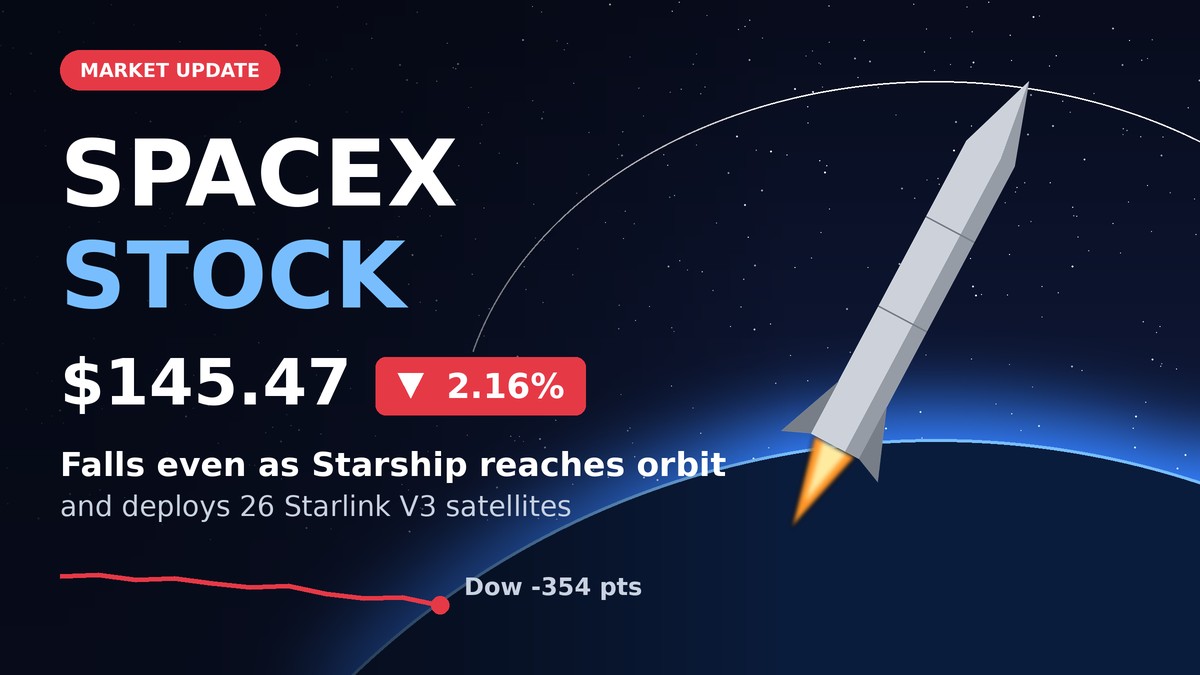
SpaceX stock closed Monday down 2.16% at $145.47, on the same day the company’s Starship rocket reached orbit for the first time. The drop says less about the flight than about the market around it: investors sold broadly as rising oil prices and Treasury yields weighed on equities.
The session’s numbers show how little the milestone mattered in the short term. The Dow Jones Industrial Average lost 354 points, and SpaceX shares (ticker SPCX) moved roughly in step with the wider selloff, giving back about $3.20 from the prior close.
Over the longer term, the flight may matter far more. Starship sits at the center of SpaceX’s plans for Starlink growth, NASA’s lunar program, and the eventual retirement of Falcon 9. That puts Monday’s orbital test at the core of the investment case that analysts at Bernstein reaffirmed this week.
Why the Market Shrugged Off a Major Milestone
Single-day moves in a large, widely held stock often track macro forces more than company news. Higher yields tend to pressure growth-oriented names, whose valuations depend heavily on earnings expected years from now. SpaceX fits that profile. The company is still losing money while it spends to build out Starship and Starlink.
The flight itself was also a qualified success, not a flawless one. Engine problems cut the mission short, which gave cautious investors little reason to buy against a falling market.
What Starship Accomplished on Flight 14
The uncrewed vehicle lifted off with its Super Heavy booster from SpaceX’s Starbase facility in Texas on the program’s 14th test flight.
Engine issues shortened the mission
Both stages ran into trouble. Some of the booster’s engines stopped working during its descent, although it still completed a controlled splashdown in the Gulf of Mexico. After stage separation, one of Starship’s three main engines shut down earlier than planned.
Engineers decided the spacecraft could keep going. A subsequent engine burn placed it into orbit, and SpaceX then trimmed the flight plan because of the engine issue.
| Flight metric | Planned | Actual |
|---|---|---|
| Mission duration | About 10 hours | About 3 hours |
| Orbits of Earth | Six | Shortened |
| Starlink V3 satellites deployed | 26 | 26 |
| Deployment altitude | Not specified | About 269 km |
All 26 satellites working
SpaceX said every one of the 26 next-generation Starlink V3 satellites was operating normally after deployment. This was the first time Starship carried the new satellite design to orbit.
Why Starship Matters to SpaceX Stock
For anyone tracking SpaceX stock, the rocket’s progress ties directly to several revenue lines.
Replacing Falcon 9
Starship is built to be fully and rapidly reusable and to carry much larger payloads at lower cost than Falcon 9, the company’s current commercial workhorse. SpaceX says Starship V3 is designed to lift around 100 metric tons to orbit. The company is winding down Falcon 9 and may stop offering new launches on it after 2028, though existing contracts are expected to be honored.
Scaling Starlink
Each V3 satellite is designed to handle roughly 10 times the data of the V2 Mini satellites that Falcon 9 currently launches. SpaceX eventually wants to put as many as 60 V3 satellites on a single Starship flight, which would sharply increase how much capacity it can add per launch.
NASA and AI compute
A version of Starship is slated to carry astronauts to the Moon under NASA’s Artemis program. SpaceX president Gwynne Shotwell also said at the All-In Summit this month that the company plans to launch AI compute satellites on Starship in 2027.
Bernstein Keeps Outperform Rating and $248 Target
Bernstein reiterated its Outperform rating and $248 price target, pointing to the growth runway in Starlink’s residential broadband business. The target sits about 70% above Monday’s close.
Analyst Douglas Harned noted that Starlink has doubled its broadband subscriber base in each of the past four years, and the firm expects it to double again in 2026. Its base case has Starlink reaching 168 million subscribers by 2031, an estimate built on the size of the global broadband market in 2026 and projected population growth. SpaceX reported about 12 million Starlink subscribers at the end of the second quarter.
Revised estimates
Bernstein made modest changes to its model. It now sees about $64 billion in Starlink revenue by 2031, down slightly from $66 billion, reflecting lower expected revenue per user as the service moves into lower-income markets. The firm also factored in a faster near-term connectivity buildout.
| Bernstein estimate | Previous | Updated |
|---|---|---|
| 2031 Starlink revenue | $66 billion | $64 billion |
| Fiscal 2026 diluted EPS | Loss of $0.20 | Loss of $0.19 |
| Fiscal 2027 EPS | $1.30 | $1.37 |
Second-quarter results in brief
SpaceX reported second-quarter revenue of $7.8 billion, up 92% from a year earlier, along with a net loss of $541 million. Connectivity revenue rose 66% to $4.29 billion on 1.7 million net subscriber additions. The AI segment, which includes xAI, brought in about $2.6 billion.
What to Watch Next
The next test for SpaceX stock is whether Starship can repeat Monday’s result without engine problems and move toward routine flights carrying full loads of V3 satellites. Faster deployment would support the subscriber growth that underpins Bernstein’s forecast. Further setbacks could push back the timeline investors are pricing in.
Disclaimer: This content was partially produced with the help of AI tools and This content is for informational purposes only and not investment advice.