
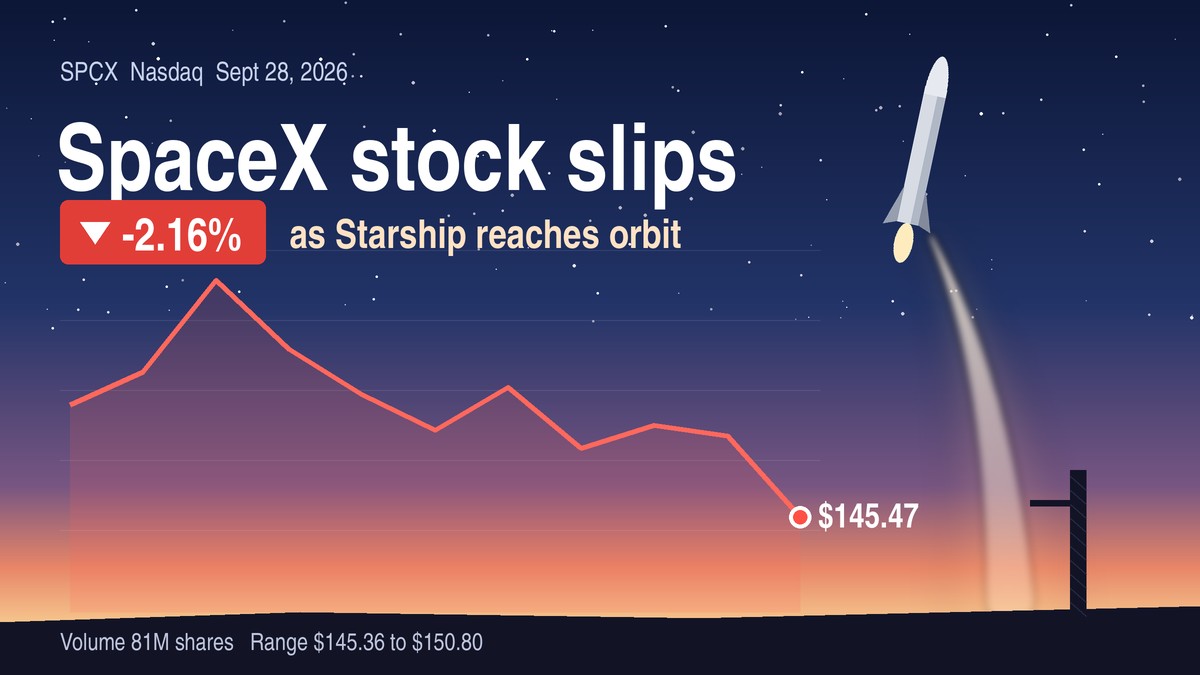
SpaceX stock closed Monday, September 28, 2026, at $145.47, down 2.16% from Friday’s $148.68 close. The drop came on the same day the company reached a major engineering milestone: Starship successfully launched into orbit for the first time on Flight 14, lifting off at 8:46 a.m. EDT from Starbase, Texas.
The session was busier than usual. About 81 million shares changed hands, worth roughly $11.86 billion, up 27 million shares from the prior day. Higher volume on a down day is something technical analysts watch closely, because it can suggest selling pressure rather than routine drift.
Monday’s move leaves the shares about 8% above the $135 IPO price, though well below their June highs. Investors are now weighing a successful but shortened test flight, a new analyst initiation, and a series of short-term technical sell signals.
How Monday’s Session Unfolded
The stock traded in a 3.74% range during the day, from a low of $145.36 to a high of $150.80, according to the source report. It has now fallen in 6 of the last 10 sessions and is down 1.81% over that period.
| Metric | Value |
|---|---|
| Previous close | $148.68 |
| Monday close | $145.47 |
| Daily change | -2.16% |
| Intraday high / low | $150.80 / $145.36 |
| Shares traded | ~81 million |
| Dollar volume | ~$11.86 billion |
| 10-day change | -1.81% |
Starship Reached Orbit, but Ended Early
The flight carried high expectations. It was the program’s first orbital mission, planned to complete about six orbits over nearly 10 hours and deploy 26 Starlink V3 satellites. The vehicle did reach orbit, but SpaceX said the flight control team limited time on orbit and deorbited Starship to a splashdown in the northern Pacific out of caution after an engine issue during ascent.
The report does not attribute Monday’s decline to any single cause, and the connection between the flight outcome and the share price has not been confirmed.
Cowen Opens Coverage With a Buy
Also on September 28, Cowen & Co. initiated coverage of SPCX with a “Buy” rating, per the source report. No price target was given. The initiation adds to a largely positive analyst picture: Investing.com lists 28 analysts recommending the stock against 2 suggesting a sale, with an average 12-month target of $222.42.
What the Technical Picture Shows
The source report, which relies on automated technical analysis, paints a mixed picture for SpaceX stock.
Mixed Moving Average Signals
The short-term moving average is flashing a sell signal, while the long-term average shows a buy signal. Because the short-term average remains above the long-term one, the report classifies the overall trend as a general buy signal. Key levels identified:
- Resistance: around $149.97 (short-term moving average)
- Support: around $144.76 (long-term moving average)
- Volume-based support: $138.74
A move above $149.97 would trigger a buy signal, the report says, while a break below $144.76 would trigger a sell signal.
Negative Signals Worth Noting
Several indicators lean bearish. A pivot top on Thursday, September 17, produced a sell signal, and the stock has fallen 6.03% since. The three-month MACD also shows a sell signal. The report’s model projects a 7.92% gain over the next three months, with a 90% probability range of $124.10 to $168.44. Those figures are model estimates, not forecasts from the company or analysts.
The report rates risk as medium, citing average daily volatility of 3.12% over the past week. It concludes that despite the negative signals, the stock is better viewed as a “hold” candidate than a sell while the trend develops.
The Bigger Picture Since the IPO
A Volatile First Few Months
SpaceX went public this summer in one of the largest listings on record. Shares were priced at $135 and began trading on the Nasdaq on June 12, 2026, closing their first day at $161, up 19%. The stock hit its 52-week high of $225.64 on June 16 and its low of $104.83 on August 3, and CNBC data puts its market capitalization at about $2.018 trillion.
Supply Concerns Linger
Share supply remains a talking point. The Motley Fool noted that more SpaceX insiders become eligible to sell shares in September, which could weigh on the price. Under the IPO terms, Musk and insiders face a 366-day lock-up, while other pre-IPO investors have staggered 180-day lock-ups.
Disclaimer: This content was partially produced with the help of AI tools and This content is for informational purposes only and not investment advice.