
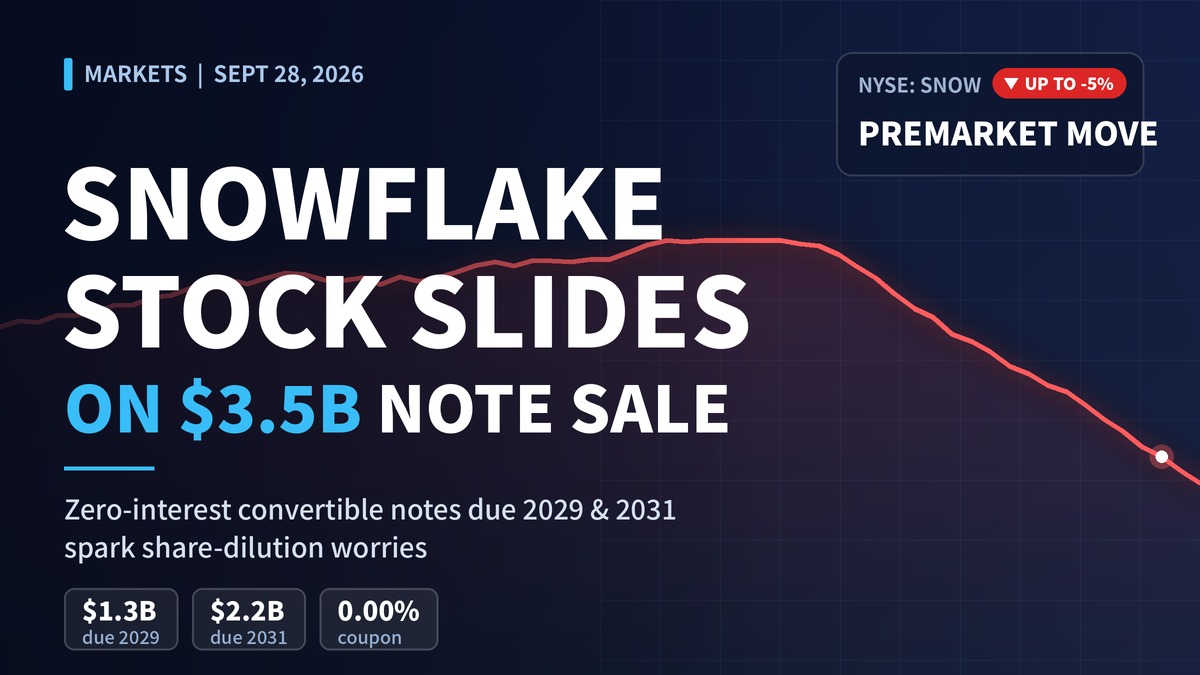
Snowflake Stock came under pressure early Monday, September 28, after the cloud data company said it plans to raise $3.5 billion by selling convertible notes that pay no interest. Shares fell as much as 5% before the opening bell, as investors weighed the chance that the notes could eventually turn into new shares and shrink the value of existing stakes.
Readings of the drop varied through the morning. One tally put the premarket decline at 4.4%, taking shares to $321.07, while another report cited a 2.7% slide at an earlier point in the session. Premarket trading is thin, so these figures should be treated as preliminary until regular trading sets a clearer picture.
The deal has not been priced yet. The conversion rate, which determines how many shares each note could become, will only be disclosed once that happens, so the real dilution math remains unknown for now.
What Snowflake Is Selling
According to the company’s press statement, the notes will go to qualified institutional buyers in a private placement, split across two maturities. The notes will be general unsecured obligations that won’t bear regular interest, and their principal amount will not accrete.
| Detail | 2029 Notes | 2031 Notes |
|---|---|---|
| Base offering | $1.3 billion | $2.2 billion |
| Additional purchase option | $200 million | $300 million |
| Maturity date | October 15, 2029 | October 15, 2031 |
| Interest rate | 0.00% | 0.00% |
Initial buyers can take up the extra notes within 13 days of issuance. If both options are fully exercised, the total raise would reach $4 billion. When holders convert, Snowflake can choose to settle in cash, common stock, or a combination of the two.
Where the Money Is Going
Snowflake laid out three uses for the proceeds. The first is funding capped call transactions, a type of derivative that limits dilution from the new notes by letting the company buy back shares at preset prices. The capped calls for each series are designed to cover the number of shares initially underlying those notes.
The second is refinancing. Part of the cash will go toward repurchasing a portion of Snowflake’s convertible notes due in 2027. The remainder is earmarked for general corporate purposes, which the company said may include buying back its own stock and notes from time to time, or acquiring and investing in complementary businesses, technologies, or assets.
Background: The 2024 Convertible Deal
This is not Snowflake’s first trip to the convertible market. In September 2024, the company issued $2.3 billion of zero-coupon convertible notes, split evenly between $1.15 billion due in 2027 and $1.15 billion due in 2029. It spent $195.5 million on capped calls tied to that offering, with a cap price initially set at $225 per share. With Snowflake shares now trading well above that level, the older capped calls offer less protection against dilution, which helps explain why the company is refinancing part of that debt.
Why Investors Are Uneasy
Convertible notes are a cheap way to borrow, especially at a 0% coupon, but they come with an equity trade-off. If the share price rises past the conversion price, holders can swap debt for stock. Capped calls soften that effect only up to a ceiling. For shareholders, the question is how much of the upside they may eventually share with noteholders.
The Profitability Gap
The raise also lands while Snowflake is still losing money under standard U.S. accounting rules (GAAP). In the second quarter of fiscal 2027, the company reported a GAAP net loss of $191.7 million, narrower than the $297 million loss a year earlier. The trend is moving in the right direction, but the company is not yet profitable on that basis.
Valuation adds to the sensitivity. Snowflake trades at a price-to-sales ratio of about 21.3, close to its historical median, a level that bakes in expectations of strong growth. Insiders have also been net sellers, unloading about $1.2 billion of shares over the past 12 months with no reported buying.
The AI Demand Story
Against those concerns sits robust demand. The ongoing AI boom continues to lift interest in Snowflake’s data warehouses, data lakes, and AI tools. One report said AI accounts for roughly half of the company’s recent growth acceleration. A larger cash cushion gives Snowflake more room to pursue acquisitions or investments in that space.
How Wall Street Views Snowflake Stock
Analysts remain firmly positive despite Monday’s dip. Snowflake Stock holds a Strong Buy consensus rating, built on 33 Buy and three Hold ratings from 36 analysts over the past three months. The average price target of $435.82 implies roughly 30% upside from recent levels.
That gap between analyst targets and the premarket reaction suggests the sell-off reflects near-term dilution concerns rather than a shift in the long-term outlook. The next key detail for Snowflake Stock will be the pricing announcement, which will reveal the conversion premium and the true scale of potential new shares.
Disclaimer: This content was partially produced with the help of AI tools and This content is for informational purposes only and not investment advice.