Micron Technology reports fiscal fourth-quarter results after the market closes on Wednesday, Sept. 30, and the numbers could matter as much for Sandisk stock as for Micron’s own shares. Sandisk sells only NAND flash, and Micron’s report is one of the earliest detailed readouts of what memory makers are charging for it.
That link has already moved markets once. The day after Micron’s previous report in June, Sandisk shares rose 22% on June 25, outpacing Micron’s own gain of roughly 16%, even though Sandisk had released no news of its own.
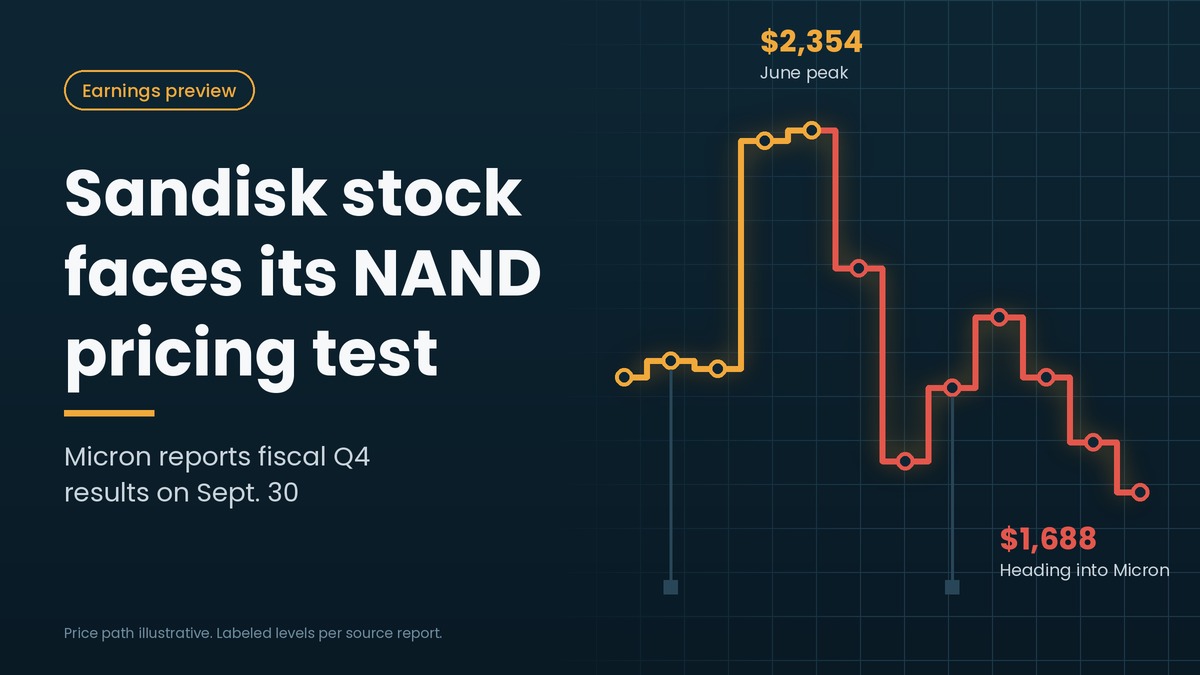
This time the setup is different. As of the source report’s writing, Sandisk traded near $1,688, about 28% below its June peak of $2,354. Shares fell about 5% on Monday after OpenAI said it had paused training its most capable AI models, according to the report.
Why Micron’s NAND Figures Move Sandisk Stock
NAND is the flash memory that stores data in phones, PCs, and data center drives. It is a minority of Micron’s business. DRAM, the memory that works alongside processors, makes up most of its sales, and NAND accounted for just 24% of revenue in the quarter ended May 28.
For Sandisk investors, though, that 24% carried the signal. Micron’s NAND revenue rose 99% from the prior quarter to $9.9 billion. Nearly all of that came from pricing: average selling prices climbed in the mid-80% range, while bit shipments grew only by a mid-single-digit percentage.
Price gains had been accelerating
The June report showed flash pricing gathering speed, not slowing down. In Micron’s fiscal second quarter, NAND revenue rose 82% sequentially on price increases in the high-70% range. The fiscal third quarter topped both figures.
| Metric | Micron FQ2 | Micron FQ3 |
|---|---|---|
| NAND revenue growth (sequential) | 82% | 99% |
| NAND price increase | High-70% range | Mid-80% range |
| NAND revenue | Not specified | $9.9 billion |
Sandisk’s own results confirmed the trend
Investors got that read about six weeks before Sandisk reported. When it did on Aug. 5, the numbers lined up. Revenue for the quarter ended July 3 reached $8.97 billion, up 51% sequentially and 372% year over year. Only about a third of the sequential gain came from higher shipments, with pricing doing the rest.
The June rally, however, faded quickly. Sandisk closed at $2,335 on June 25 and at $1,745 on July 2, below its level before Micron reported.
The Overlap Between the Two Companies’ Quarters
Timing is what makes Wednesday’s report useful. Micron’s fiscal fourth quarter ran 14 weeks and ended in early September, covering roughly June through August. Sandisk’s current quarter began July 4, so Micron’s data spans about two months of it, well before Sandisk is expected to report those months itself later this fall.
What Sandisk has already guided
Sandisk management has signaled that growth is cooling. The company guided fiscal first-quarter revenue of $10.3 billion to $10.8 billion, roughly 15% to 20% above the prior quarter, and a non-GAAP gross margin of 83% to 85%, compared with 84.6% last quarter.
Rising revenue with a flat margin implies the company expects price increases to slow considerably from the spring pace. Micron’s figures offer an early outside check on that assumption.
Three Numbers to Watch on Wednesday
NAND price growth
The headline figure for Sandisk stock is how much Micron’s NAND prices rose in the quarter. After two straight quarters of gains above 75%, a much smaller increase would still be an increase. A sharp slowdown, though, could suggest the pricing behind Sandisk’s 84.6% gross margin is leveling off.
Data center SSD demand
Micron’s data center solid-state drive revenue topped $5 billion in fiscal Q3, more than doubling from the prior quarter. That is the same market driving Sandisk’s fastest-growing segment, where revenue rose 103% sequentially to about $3 billion, or roughly a third of total sales.
The supply outlook
In June, Micron said it expected supply of both DRAM and NAND to stay tight relative to demand beyond calendar 2027, with NAND more constrained as suppliers shift cleanroom space toward DRAM. Any softening of that view would likely weigh more heavily on Sandisk, which has no DRAM business to offset weaker flash pricing.
How the market is valuing Sandisk
Sandisk’s valuation suggests investors already doubt that current flash prices will hold. At about $1,688, the stock traded at roughly 23 times trailing earnings. Annualizing the $44 to $46 of adjusted earnings per share guided for the current quarter puts it below 10 times earnings.
A single Micron report will not settle how long elevated flash prices last. But its NAND data covers most of the quarter Sandisk is now closing out, and in June that was enough to move Sandisk more than Micron itself.
Disclaimer: This content was partially produced with the help of AI tools and This content is for informational purposes only and not investment advice.