
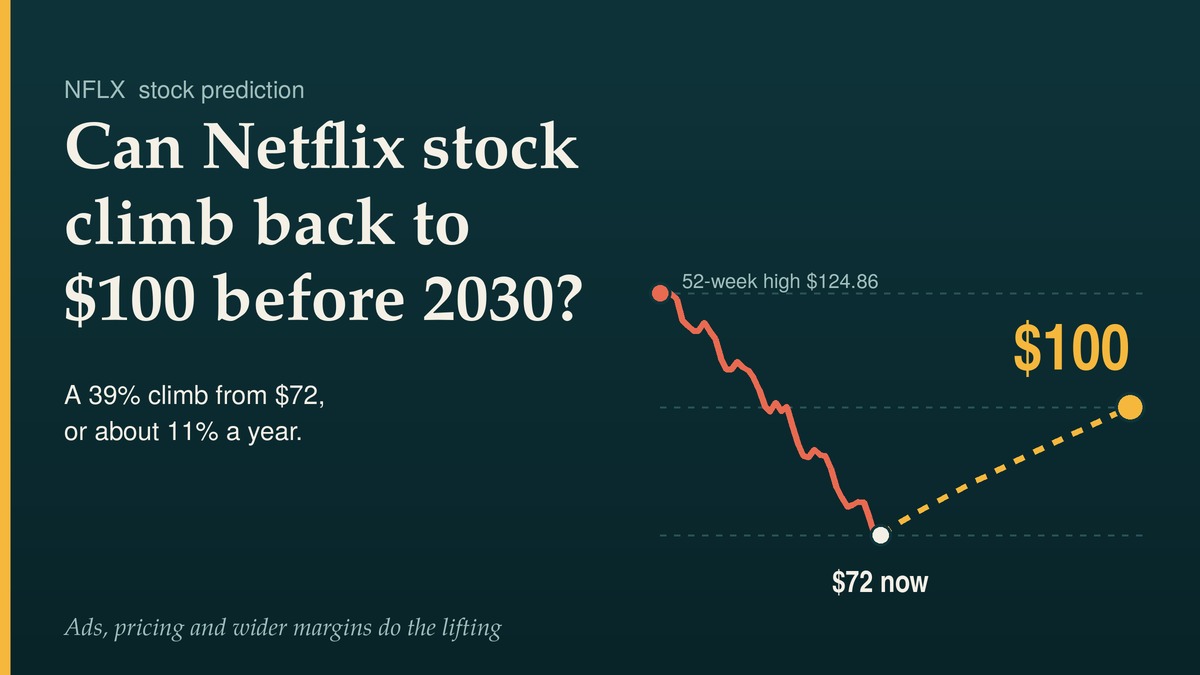
Netflix shares have lagged well behind the company’s actual results, and one recent analysis argues that gap sets up a climb back to $100 per share before 2030. At the time the analysis was written, the stock traded near $72, roughly 43% below its 52-week high of $124.86, even as second-quarter operating income rose 11% year over year.
The case doesn’t rely on a bullish leap. It assumes Netflix mostly hits its own published targets, including 2026 revenue of $51.0 billion to $51.4 billion and an operating margin of 31.5%. Reaching $100 from $72 requires a 39% gain, or about 11% a year over the roughly three and a quarter years left before 2030.
Whether that happens depends on two things: revenue growth that stops decelerating near 11%, and continued margin expansion. The prediction Netflix stock investors are weighing is therefore less about sentiment and more about whether the company executes on guidance it has already given.
How the $100 Target Is Built
The projection works backward from 2029 earnings rather than betting on a richer valuation. Here is how the key assumptions stack up.
| Metric | 2024 | 2025 | 2026 (guidance) | 2029 (projected) |
|---|---|---|---|---|
| Revenue | n/a | n/a | $51.0B to $51.4B | About $70B |
| Operating margin | 26.7% | 29.5% | 31.5% | About 36% |
| Operating income | n/a | n/a | n/a | About $25B |
| Earnings per share | n/a | n/a | n/a | About $5.20 |
The 2029 figures assume revenue grows about 11% annually from the midpoint of guidance, and the margin widens by roughly 1.5 percentage points a year. That pace is slower than the expansion of the past two years. Taxes and interest are assumed to take about the same share of operating income as in 2025, while buybacks trim the share count by around 2% a year, matching the decline in diluted shares over the past year.
What Valuation That Implies
At $100, Netflix would trade at about 19 times projected 2029 earnings. That is close to the multiple the stock currently carries on analysts’ consensus estimate for 2027. This year’s earnings are a poor comparison point because a $2.8 billion Warner Bros. termination fee inflates them.
In other words, the target rests on profit growth, not on investors deciding to pay more for each dollar of earnings.
Advertising and Price Increases Carry the Load
Revenue growth is the harder assumption. Year-over-year growth was 16% in the first quarter and 13% in the second, and Netflix guided for roughly 12% in the third. Growth is sliding toward the 11% the projection needs, and it largely has to level off there.
The Ad Business
Advertising is expected to do much of the work. Netflix’s ad revenue topped $1.5 billion in 2025, more than two and a half times the 2024 total, and management expects about $3 billion this year. If ad sales reach around $9 billion by 2029, they would supply about a third of the roughly $19 billion in added annual revenue the path requires. Going from $3 billion to $9 billion in three years works out to about 44% annual growth, well below this year’s doubling but still a steep climb.
Memberships and Pricing
Everything else has to come from subscriptions and pricing. Excluding ads, guidance implies about 10% revenue growth this year, and the projection needs roughly 8% annually after that. Management said price changes in the first half of the year, including in the U.S., performed in line with past increases.
A Soft Spot in the Home Market
Growth in the U.S. and Canada slowed from 18% in the fourth quarter of 2025 to 14% and then 10% across the first half of 2026. Management noted, however, that the second quarter captured only part of the latest price change’s effect in that region, which could help growth steady.
What Happens if Growth Falls Short
The analysis tests a weaker scenario. If revenue grows only 8% a year through 2029 with the same margin and buyback assumptions, earnings per share land near $4.80. A $100 share price would then equal about 21 times earnings, higher than the stock’s multiple on next year’s expected profits but not extreme for a business this profitable.
The margin side looks sturdier. Netflix expects content amortization, the cost of programming spread over time, to rise about 10% in 2026, slower than its forecast revenue growth of 13% to 14%. If costs keep trailing sales, margins should continue widening.
The Risks
Growth might not settle at 12%. Streaming is crowded, and a mix of single-digit growth and a flat margin could leave shares well short of $100. The author of the analysis also considers the stock fairly priced near $72, describes an 11% annual return as healthy rather than exceptional, and cautions that any forecast beyond three years is an educated guess. For anyone tracking this prediction, Netflix stock’s path hinges on quarterly revenue trends and ad sales holding up against those assumptions.
Disclaimer: This content was partially produced with the help of AI tools and This content is for informational purposes only and not investment advice.