
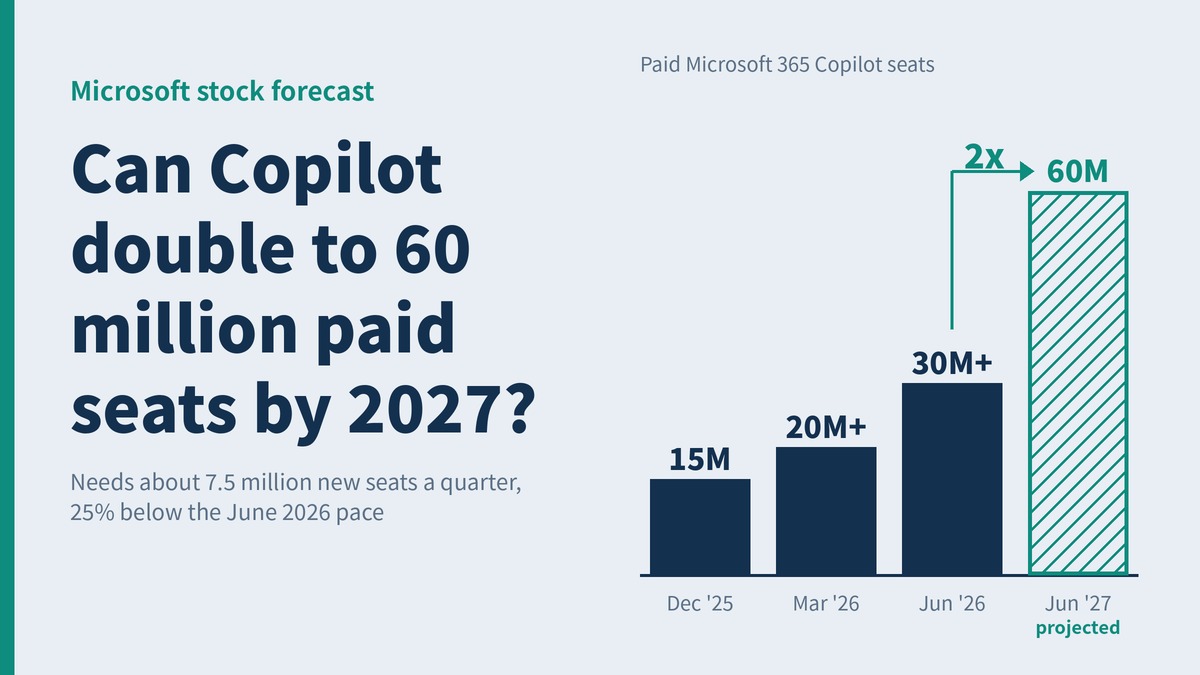
Microsoft ended its fiscal 2026 with more than 30 million paid Microsoft 365 Copilot seats. About 10 million of those were added in the April-to-June quarter alone. That pace has led to a new forecast: Microsoft will report at least 60 million paid seats by the end of June 2027, doubling its base in one year.
The math behind the call is less aggressive than it sounds. Reaching 60 million would take about 7.5 million net new seats per quarter, roughly 25% below the rate Microsoft just posted. Copilot also still covers a small slice of the company’s customer base, only about 7% of its more than 450 million paid Microsoft 365 commercial seats.
The seat trajectory matters for anyone building a prediction Microsoft stock can hold its premium valuation, because Copilot is already lifting revenue per user. The seat target is an outside projection, not company guidance. Microsoft’s September-quarter report will be the first read on whether the momentum carried into fiscal 2027.
How Fast Copilot Seats Have Grown
Adoption has sped up sharply over the past three quarters, based on figures Microsoft disclosed on earnings calls.
| Period ending | Paid Copilot seats | Approx. seats added in quarter |
|---|---|---|
| December 2025 | 15 million | n/a |
| March 2026 | More than 20 million | About 5 million |
| June 2026 | More than 30 million | About 10 million |
| June 2027 (projected) | 60 million | About 7.5 million per quarter needed |
In April, CEO Satya Nadella said seat additions in the March quarter grew 250% year over year. The June quarter then more than doubled that quarter’s additions.
Bigger customers, bigger commitments
Deal sizes are growing too. On the July earnings call, Nadella said the number of customers with more than 50,000 Copilot seats had grown more than sevenfold year over year. HSBC alone committed to 200,000 seats.
The Bigger Story Is Revenue Per User
Seat counts get the headlines, but the financial effect shows up in pricing power. In fiscal 2026, which ended June 30, Microsoft 365 commercial cloud revenue rose 17% while paid commercial seats grew only 6%. Microsoft’s annual report credits that gap mainly to Microsoft 365 Copilot and its E5 offering.
Across products and cloud services, the Microsoft 365 commercial business brought in about $102 billion for the year, up 16%. For the September quarter, management guided in July for Microsoft 365 commercial cloud revenue growth of about 16% in constant currency, adjusted for an unusual prior-year comparison. That figure rises to about 18% after Microsoft moved GitHub and Security Copilot revenue into the line.
Chief Financial Officer Amy Hood was upbeat on the July call: “[W]e expect to see acceleration in M365 Commercial cloud revenue growth through this fiscal year.”
The cost of running AI at scale
Copilot is not cheap to deliver. Cost of revenue in the productivity and business processes segment, which includes Microsoft 365, rose 12% in fiscal 2026. Microsoft attributed the increase to AI infrastructure supporting Copilot’s seat and usage growth. Even so, the segment’s operating income climbed 20%, so revenue is still outrunning the added cost.
What Could Speed Up or Slow Down Adoption
A larger bundle
Since May 1, Microsoft has sold a Microsoft 365 E7 suite that combines Copilot with its E5 offering and Agent 365, a tool for managing AI agents. Bundling puts Copilot in front of buyers already paying for premium tiers.
A rebuilt Copilot app
On Sept. 25, Microsoft announced a redesigned Copilot app with Word, Excel, and PowerPoint built in. The change signals that Microsoft wants users to start their work inside Copilot rather than treat it as an add-on. The new version will reach users first through Microsoft’s Frontier early-access program in the coming weeks, so any effect on seat sales is not yet measurable and may take several quarters to appear.
Background: how Copilot is sold
Microsoft 365 Copilot became generally available to enterprise customers on Nov. 1, 2023, as a paid add-on priced at $30 per user per month. Because it sits on top of existing Microsoft 365 licenses, the company’s large installed base is the main pool of potential buyers. That base has been growing about 6% a year.
What the Market Already Prices In
Even at 60 million seats, Copilot would reach only about one in eight paid Microsoft 365 commercial users, which leaves plenty of room to grow. Investors are already paying for much of that potential, though. At around $516 per share as of late September, Microsoft trades at about 29 times fiscal 2026 earnings, compared with roughly 26 times for the S&P 500. That valuation arguably reflects a good deal of expected AI success already.
The seat forecast is a narrower claim than a prediction Microsoft stock will outperform. Microsoft only needs to keep adding seats at a slower pace than it just achieved. Timing remains the main risk: a soft quarter or two could push the 60 million milestone back by a few months, and the forecast depends on enterprise buying patterns that can change quickly.
Disclaimer: This content was partially produced with the help of AI tools and This content is for informational purposes only and not investment advice.