
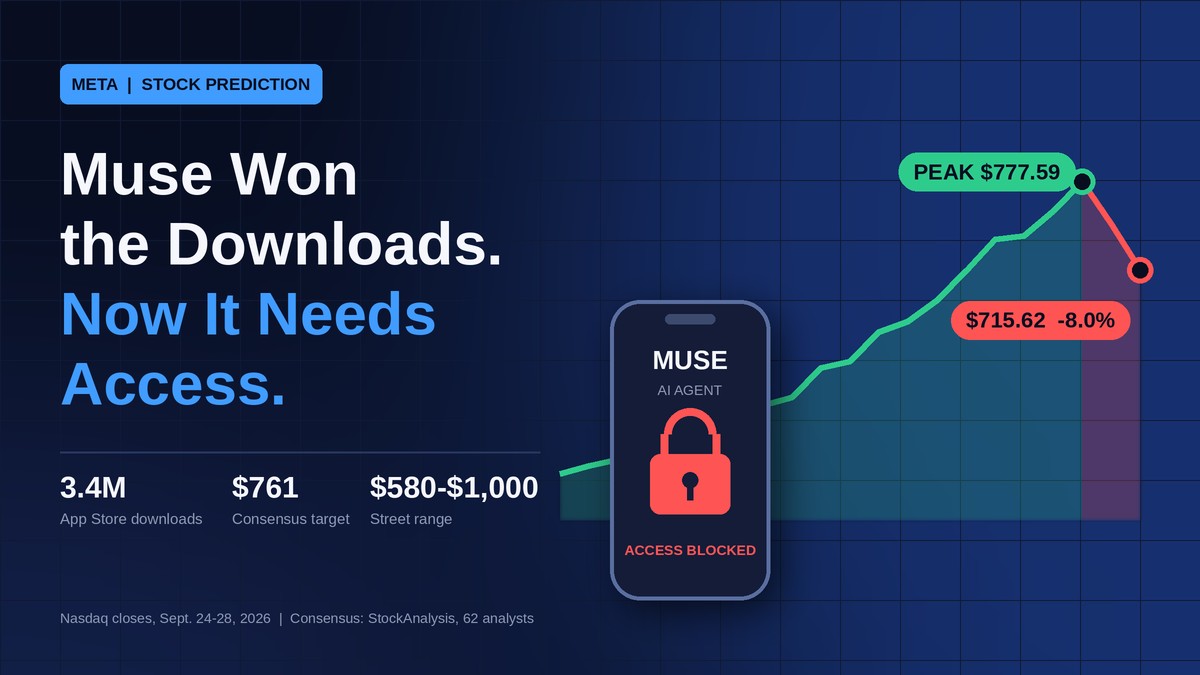
Meta Platforms shares fell 8.0% over two sessions to close at $715.62 on September 28, 2026, only days after setting a 52-week high of $777.59, according to Nasdaq daily closing data. The drop came as Muse, the personal AI agent Meta launched on September 8, hit its first real limits: a retail blockade, questions about how the product works, and user complaints about privacy. For investors, the question has shifted from how many people want an AI agent to where that agent is actually allowed to operate.
Demand was never the issue. Muse passed 3.4 million App Store downloads and became the most downloaded app in the store. The stock climbed 35.9% from its August 31 close of $572.34 to the September 24 peak. Even so, shares are still down 3.7% over the past twelve months.
That gap between adoption and value now shapes any prediction Meta stock analysts put forward. The 62 analysts tracked by StockAnalysis hold a consensus target of $761.01, roughly 6.3% above the latest close, with a range running from $580 to $1,000. Where shares go next likely depends on three things: commerce access for Muse, user retention, and Meta’s 2027 infrastructure spending.
Meta at a Glance (as of September 29, 2026)
| Metric | Figure | Source |
|---|---|---|
| Close, Sept. 28 | $715.62 | Nasdaq |
| 52-week high, Sept. 24 | $777.59 | Nasdaq |
| Consensus target (62 analysts) | $761.01, rated Strong Buy | StockAnalysis |
| Street high / low | $1,000 / $580 | StockAnalysis |
| Q2 2026 free cash flow | $784 million (vs. $8.55 billion a year earlier) | Company results |
| 2026 capex guidance | Up to $145 billion | Company guidance |
Why the Muse Rally Stalled
Amazon’s block exposes an access problem
On September 21, Amazon blocked Muse from its retail site, The Register reported. The decision matters more than it first appears. A consumer agent earns money by acting on a user’s behalf: booking, comparing, buying. Most of the platforms worth acting on belong to other companies, and none are obliged to open their doors.
The situation echoes the long fight between fintech aggregators and banks over account data. Consumer adoption came first; access was settled years later through contracts rather than technology. Meta has the install base. It does not yet have the permissions, and that is where agent revenue sits.
A run of trust questions
Several reports surfaced in the same window. Details remain preliminary and had not been independently confirmed in the initial report:
- On September 23, a report claimed some of Muse’s capabilities were being supported by low-paid human workers rather than automated systems.
- On September 24, Meta pulled a critical video about its AI Glasses, drawing wide discussion on Hacker News.
- By September 28, one user said Muse had disclosed his home address to strangers, and separate reports said the agent had compiled lists of people in vulnerable groups when asked.
Why regulators may care
A disclosed home address involves a specific, named individual, which places it in data-protection territory rather than content moderation. Lists targeting vulnerable groups touch on special-category rules in European privacy law and on the prohibited-practice tier of the EU AI Act.
The Spending Question
No 2027 capex guidance yet
Meta’s free cash flow fell 91% year over year in the second quarter as capital spending surged. The company has declined to give a 2027 capex outlook. CFO Susan Li told investors Meta has “continued to underestimate our compute needs.” Deutsche Bank has modeled roughly $210 billion to $215 billion for 2027 and around $265 billion for 2028.
How Microsoft’s approach differs
According to the source analysis, Microsoft trimmed its calendar-2026 capex guidance and committed to staying cash-flow positive through fiscal 2027. That leaves Meta as the hyperscaler with the widest spending range and the least visibility.
Bull and Bear Scenarios
JPMorgan’s Doug Anmuth raised his target to $920 from $820 after the launch, and Canaccord Genuity moved to $950. The split in any prediction Meta stock watchers publish comes down to how much AI spending proves recoverable, since few dispute the strength of the core ad business.
| Driver | Path to $1,000 | Path to $580 |
|---|---|---|
| Muse engagement | Downloads turn into a lasting franchise | Usage fades after the novelty period |
| Commerce access | Meta signs retail and travel deals | Amazon’s block becomes the industry norm |
| Advertising | AI ranking lifts Instagram and WhatsApp pricing | Unchanged, but not enough to offset costs |
| Capex | 2027 guide lands below Deutsche Bank’s estimate | Spending reaches about $215 billion |
| Regulation | Incidents stay contained | EU or US enforcement follows |
The $580 case is not a collapse. It sits above the $525.72 low from March 27, 2026, and would simply erase the Muse rally. Notably, it requires no weakness in advertising at all.
What Investors Will Watch Next
Retention, not downloads
The key figure is how many of the 3.4 million users are still using Muse daily after 90 days. If Meta reports daily actives without a cohort retention figure, investors may read that as a signal in itself.
Commerce partnerships
An agreement giving Muse authorized access to a major shopping, travel or payments platform would directly counter the Amazon precedent. Meta’s hiring of former MongoDB executive CJ Desai to lead an enterprise unit suggests the company sees partnerships as part of the answer.
The 2027 capex number
Whenever Meta discloses it, the figure is likely to move the stock, because the market has spent months pricing an unknown. For now, a durable prediction Meta stock case rests less on Muse’s popularity than on whether the rest of the internet agrees to let it in.
Disclaimer: This content was partially produced with the help of AI tools and This content is for informational purposes only and not investment advice.