
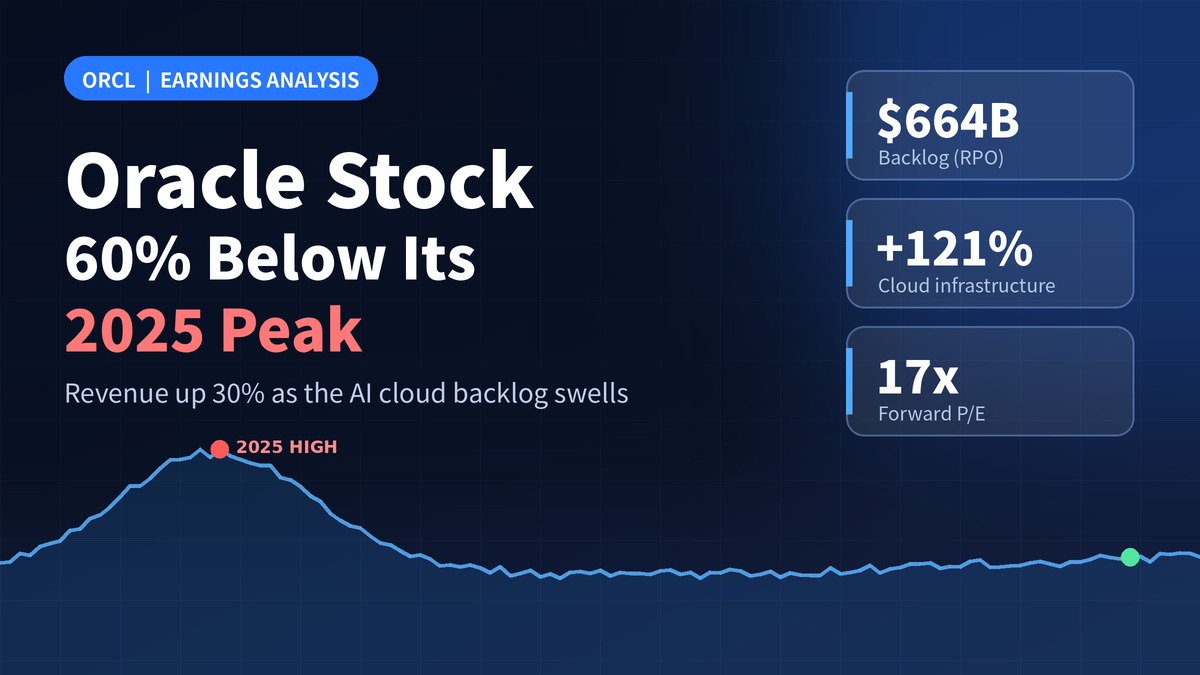
Oracle’s latest quarterly report showed growth that is rare for a company its size, yet Oracle stock still trades roughly 60% below its 2025 high, according to the original analysis. The first-quarter fiscal 2027 results came out on September 10, 2026. They sharpened a debate over whether Oracle’s heavy AI infrastructure spending is paying off fast enough.
The backlog is the headline number. Remaining performance obligations reached $664 billion, up $209 billion from a year earlier and $26 billion from the prior quarter, ahead of the StreetAccount consensus of $630.6 billion. Even so, the shares sit at about 17 times forward earnings, and analysts have been raising their profit estimates.
The open question is conversion. Can Oracle turn signed contracts into recognized revenue without straining its balance sheet or issuing new shares? Management sounded confident. The company guided second-quarter revenue growth of 30% to 34% and raised its full-year revenue outlook to at least $90 billion.
Oracle’s Fiscal Q1 2027 by the Numbers
Revenue came in at $19.35 billion, up about 30% and above the roughly $19.1 billion consensus, while adjusted EPS of $1.92 beat the $1.74 estimate. Total cloud revenue grew 62% to $11.6 billion, and cloud infrastructure revenue more than doubled, rising 121% to $7.4 billion.
| Metric | Q1 FY2027 | Year-over-year change |
|---|---|---|
| Total revenue | $19.35 billion | +30% |
| Cloud revenue | $11.6 billion | +62% |
| Cloud infrastructure | $7.4 billion | +121% |
| Software revenue | $5.55 billion | -3% |
| Adjusted EPS | $1.92 | +30% |
| Remaining performance obligations | $664 billion | +$209 billion |
| Operating cash flow | About $23 billion | +184% |
Cloud Infrastructure Carries the Growth
On the earnings call, CFO Hilary Maxson said the company saw “strong conversion” of its backlog during the quarter. The physical buildout supports that claim. Oracle delivered 850 megawatts of AI capacity with more than 300,000 GPUs in the quarter, nearly triple its fourth-quarter deliveries, and GPU utilization stayed high at 97.9%.
The Legacy Business Is Shrinking
The older business is moving the other way. Software revenue fell 3% to $5.5 billion, while services rose 5% to $1.4 billion and hardware climbed 15% to $0.8 billion.
Why Oracle Stock Remains Under Pressure
Spending Is Outrunning Cash Generation
The original report notes that operating cash flow jumped 184% to about $23 billion in the quarter and reached $47 billion over the trailing 12 months. Capital spending grew even faster, though. Capex hit $28.5 billion in a single quarter, compared with $8.5 billion a year earlier, leaving free cash flow at negative $5.4 billion. Full-year capex guidance is $90 billion to $95 billion, with net cash capex after customer prepayments and financing arrangements expected to stay at or below $70 billion.
Debt and Dilution Concerns
Oracle’s debt-to-equity ratio stands at 2.53, meaning debt exceeds shareholders’ equity. That exposure could hurt if AI infrastructure demand cools. Investors also worry that funding the backlog will require more borrowing or new shares.
Management pushed back on that concern. Maxson said most of the more than $30 billion in new AI contracts signed during the quarter used prepayment, bring-your-own-hardware, or similar structures that do not require extra capital from Oracle. CEO Clay Magouyrk argued that Oracle’s capex should now be viewed as decoupled from its growth rate, with suppliers and customers sharing the capital burden.
How Fast the Backlog Turns Into Revenue
The timing of revenue recognition matters as much as the size of the backlog. Oracle’s 10-Q filing shows it expects about 13% of the $664 billion to become revenue in the next 12 months, 37% in months 13 to 36, 34% in months 37 to 60, and the remaining 16% after that.
| Period | Share of RPO | Approximate value |
|---|---|---|
| Next 12 months | 13% | $86 billion |
| Months 13 to 36 | 37% | $246 billion |
| Months 37 to 60 | 34% | $226 billion |
| Beyond 60 months | 16% | $106 billion |
Taken together, the first two periods account for roughly half the backlog within three years, in line with management’s outlook. The steepest ramp comes in the second period, so capacity delivery over the next two years is the key test.
What RPO Measures
Remaining performance obligations represent contracted revenue that has not yet been recognized. For scale, Oracle reported RPO of $455 billion a year earlier, a figure that was itself up 359% at the time.
What Investors Are Watching Next
Bulls argue that Oracle stock at 17 times forward earnings does not reflect the cash flow that could follow if conversion continues at this pace. Skeptics point to negative free cash flow, a leveraged balance sheet, and margin pressure. Gross margin declined as expected because of the data center ramp and the shift toward infrastructure revenue, and management anticipates a further step-down. The second-quarter report will show whether capacity deliveries keep pace with the contracts already signed.
Disclaimer: This content was partially produced with the help of AI tools and This content is for informational purposes only and not investment advice.