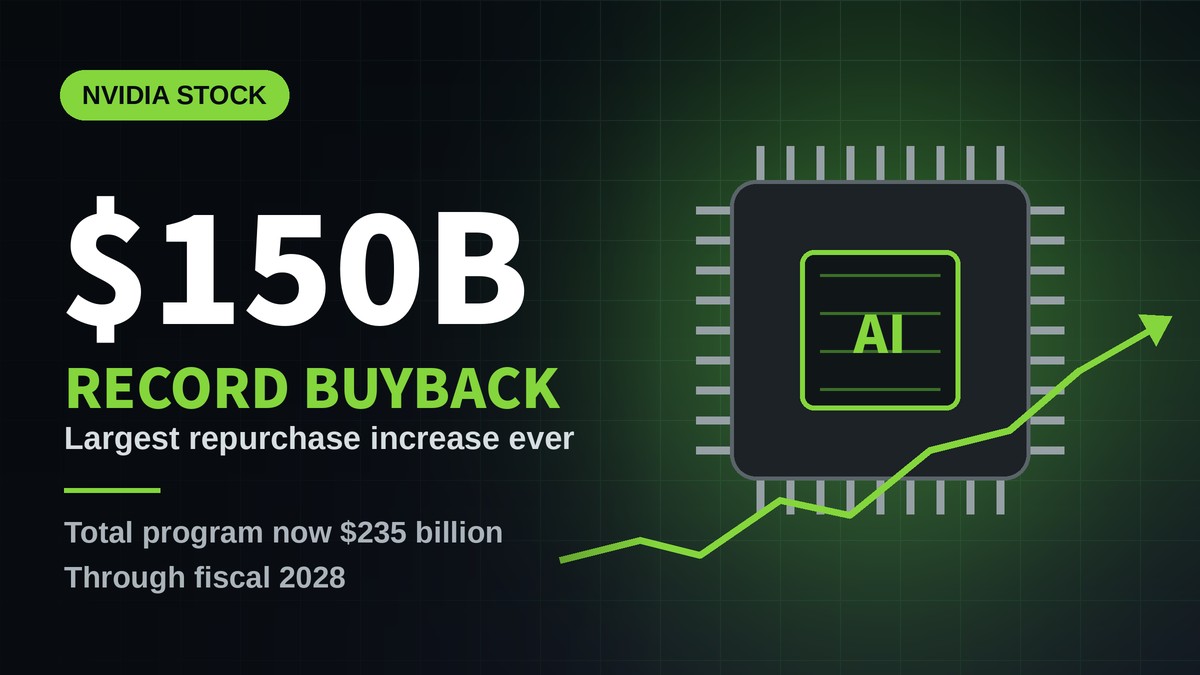
Nvidia’s board of directors has authorized an additional $150 billion under the company’s existing share repurchase program, increasing the total remaining amount authorized to $235 billion. The announcement came Monday, Sept. 28, and the company described it as the largest share repurchase authorization increase in history. It arrives at a moment when Nvidia stock has trailed the company’s own earnings growth for much of 2026.
The jump is large even by Big Tech standards. The increase lifts the total in Nvidia’s buyback program from $85 billion to $235 billion, and the previous record belonged to Apple, which authorized a $110 billion buyback in 2024, according to The Hill.
Nvidia expects to execute the total remaining program through fiscal year 2028. What it did not say is how fast. The company disclosed no fixed quarterly repurchase schedule or how many shares it expects to acquire, which leaves the pace of buying as the open question for shareholders.
What the $235 Billion Authorization Actually Means
A buyback authorization is a ceiling, not a commitment. The board’s approval does not require Nvidia to repurchase a specific amount of stock immediately; it raises the amount available under the existing program and sets a framework for additional repurchases through fiscal 2028. Nvidia also did not announce any changes to its dividend policy.
| Item | Figure |
|---|---|
| Remaining authorization before Sept. 28 | $85 billion |
| New increase approved | $150 billion |
| Total remaining authorization | $235 billion |
| Expected execution window | Through fiscal 2028 |
| Previous record single authorization | Apple, $110 billion (2024) |
How Jensen Huang Framed the Decision
In the company’s press release, CEO Jensen Huang linked the move to the company’s cash generation, saying “This authorization reflects our confidence in the long-term opportunity ahead.” He told CNBC that Nvidia expects to generate substantial cash in the coming years and wants to return more of it to shareholders as that cash grows.
Why Nvidia Stock Has Lagged Its Earnings
Nvidia shares are up more than 20% so far this year, according to the original report, a solid gain but a slower one than investors grew used to during the early AI boom. CNBC put the 12-month gain at 24%, with the company’s market value at $5.42 trillion.
Several pressures have held the stock back. Worries about rising inflation and the rapid pace of AI infrastructure spending have weighed on growth stocks broadly. Some investors also took profits in Nvidia and rotated into AI names that had not run up as much. With earnings rising faster than the share price, the stock now trades at about 24 times forward earnings estimates, per the original report.
The Latest Quarterly Numbers
The business itself has kept accelerating. Nvidia reported second-quarter revenue last month that was up sharply from a year earlier, driven overwhelmingly by data centers, and guided for $108 billion, plus or minus 2%, in the third quarter.
| Metric (Q2) | Result | Year-over-year change |
|---|---|---|
| Total revenue | $96.2 billion | Up 106% |
| Data center revenue | $89 billion | Up 117% |
| Q3 revenue guidance | $108 billion (±2%) | Not applicable |
What Comes Next for Nvidia
Demand signals remain strong. Combined hyperscaler capital expenditure is projected to exceed $1.3 trillion by 2027, according to CNBC, and analysts cited in the original report expect the broader AI market to top $1 trillion early in the next decade. Nvidia is also expanding beyond hardware: The Hill reported that the company has reached a deal to acquire open-source AI platform Hugging Face for $12.93 billion.
For holders of Nvidia stock, the buyback’s real effect will depend on execution. Repurchases reduce the share count over time, which can lift earnings per share, but the benefit hinges on how much Nvidia buys and at what prices. The company has not given that detail yet.
Background: How Nvidia Built Its Lead
Nvidia makes the graphics processing units used to train AI models and run them once deployed. It entered the market early and refreshes its GPU lineup annually, a cadence that has helped it stay ahead of rivals. It has since added enterprise software and networking products. Over the past five years, its annual revenue has climbed more than 700% and its share price more than 800%, according to the original report.
Disclaimer: This content was partially produced with the help of AI tools and This content is for informational purposes only and not investment advice.