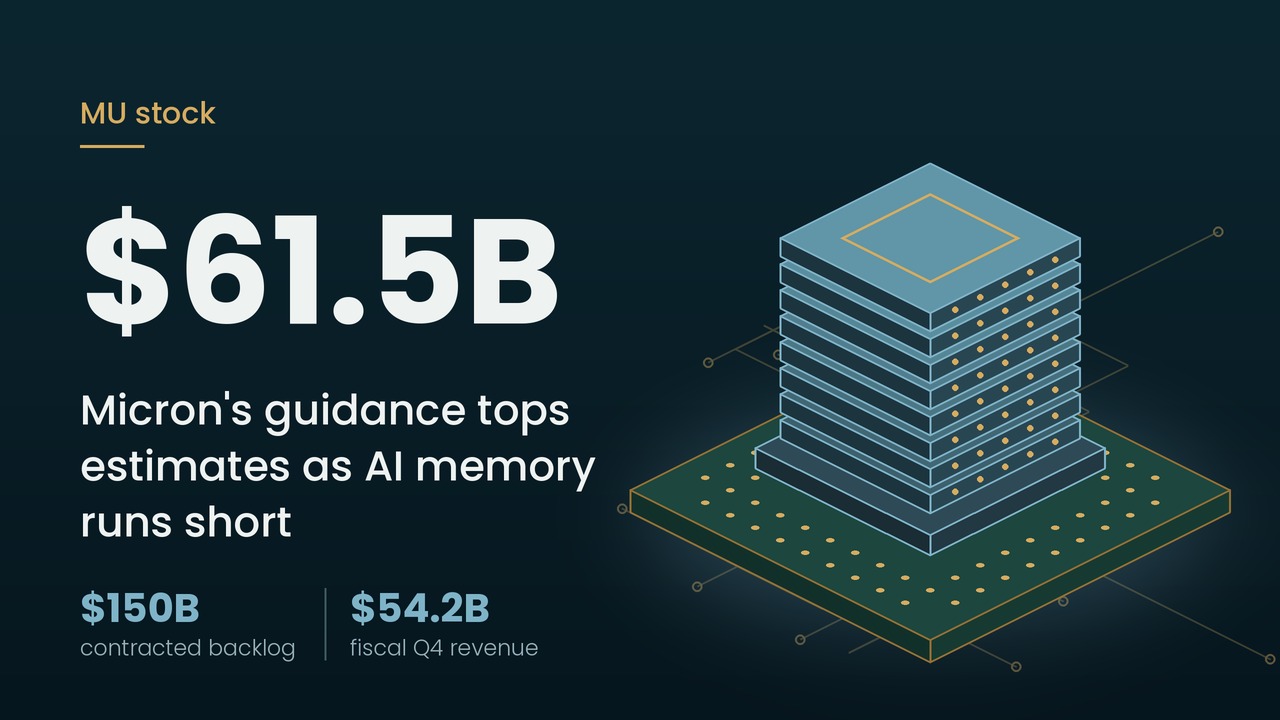
Micron Technology forecast fiscal first-quarter revenue well above Wall Street expectations, saying that customer demand for memory used in artificial intelligence data centers is still running ahead of what the industry can produce. The outlook came alongside a fiscal fourth quarter in which revenue grew nearly fivefold from a year earlier.
The company guided to revenue of about $61.5 billion, plus or minus $1.5 billion, against an average analyst estimate of $57 billion compiled by LSEG. Even the low end of that range clears consensus by roughly $3 billion. Micron also projected adjusted earnings of $38.15 per share, plus or minus $1, compared with the $35.40 analysts expected.
Despite the beat, MU stock briefly rose more than 1% in extended trading, then gave up the gain and traded slightly lower. For investors, the larger signal may be in Micron’s contract book: the company said customers have committed far more money to future supply, and management expects shortages to worsen over the next two fiscal years rather than ease.
Why the Contract Backlog Matters More Than One Quarter
Memory has historically been a boom-and-bust business, with prices collapsing whenever supply catches up to demand. Micron’s latest figures suggest customers are paying up front to avoid being left short, which changes how predictable its revenue looks.
Long-Term Supply Agreements
| Metric | Previously reported | Latest |
|---|---|---|
| Customer financial commitments | $22 billion (June) | $32 billion |
| Remaining performance obligations | About $100 billion (prior quarter) | About $150 billion |
CEO Sanjay Mehrotra said most of those commitments are backed by cash deposits. Remaining performance obligations represent contracted revenue Micron expects to recognize in later periods, so a $50 billion jump in a single quarter points to buyers reserving capacity well into the future.
The company said in its outlook that it expects memory and storage supply-demand conditions to be “much tighter in fiscal 2027 and 2028 than they were in 2026.” Chief Financial Officer Mark Murphy added that fiscal 2027 should be another record year, with revenue rising sequentially every quarter.
A Quarter That Beat on Every Headline Number
| Fiscal Q4 measure | Result | Year earlier | Analyst estimate |
|---|---|---|---|
| Revenue | $54.23 billion | $11.32 billion | $51.07 billion |
| Adjusted EPS | $33.42 | n/a | $31.61 |
| Net income | $37.7 billion ($32.87/share) | $3.2 billion ($2.83/share) | n/a |
DRAM Now Drives Nearly Three-Quarters of Sales
DRAM revenue reached $39.8 billion in the fourth quarter, up 343% from a year earlier and equal to 73% of total revenue. That concentration shows how sharply Micron’s business has tilted toward AI infrastructure and other high-performance computing workloads.
Micron’s Position in the HBM Race
High-bandwidth memory is the product at the center of this cycle. Nvidia, AMD and other chipmakers need increasing amounts of it for processors that train and run AI models.
Micron competes with South Korea’s SK Hynix and Samsung Electronics, the only other large suppliers. It holds the smallest share of the three, yet Mehrotra said agreements already cover most of Micron’s fiscal 2027 HBM output. In practical terms, the limit on its growth is factory capacity, not customer interest.
Custom Work With Nvidia
Mehrotra said Micron is working with Nvidia on what he called the industry’s first custom HBM implementation, and described the company’s roadmap for future HBM products as strong. Neither the source report nor the company provided a timeline for that product.
What Makes HBM Different
HBM stacks multiple layers of DRAM to deliver far greater memory bandwidth than conventional designs. That speed matters because AI processors can sit idle if memory cannot feed them data quickly enough.
Spending to Catch Up With Demand
Micron raised its planned U.S. investment to more than $250 billion through 2035 after customer orders outstripped its manufacturing capacity. It also plans to lift fiscal 2027 capital spending above earlier targets.
Two large campuses anchor that build-out. Construction started in January on a project in Clay, New York, and a new fabrication plant in Boise, Idaho, is scheduled to begin production next year. SK Hynix and Samsung are expanding HBM capacity in South Korea at the same time.
What Investors Are Weighing
The rally behind MU stock has been steep. Shares have more than tripled in 2026 and gained over 500% across the past 12 months, lifting Micron’s market value above $1.2 trillion. That run helps explain the muted after-hours reaction: much of the good news was arguably already priced in.
The broader demand picture remains supportive. Amazon, Alphabet and other large technology companies are expected to spend more than $730 billion on AI infrastructure this year. Hendi Susanto of Gabelli Funds called the quarter another strong beat paired with a raised forecast, and said he had seen no evidence that the memory cycle is heading toward a near-term downturn.
The Cost for Consumers
Tight memory supply is not confined to data centers. Higher component prices have spread into consumer electronics, raising costs for laptops, tablets and other devices that depend on DRAM and storage. If Micron’s forecast of tighter conditions through 2028 holds, that pressure may persist as well.
Disclaimer: This content was partially produced with the help of AI tools and This content is for informational purposes only and not investment advice.