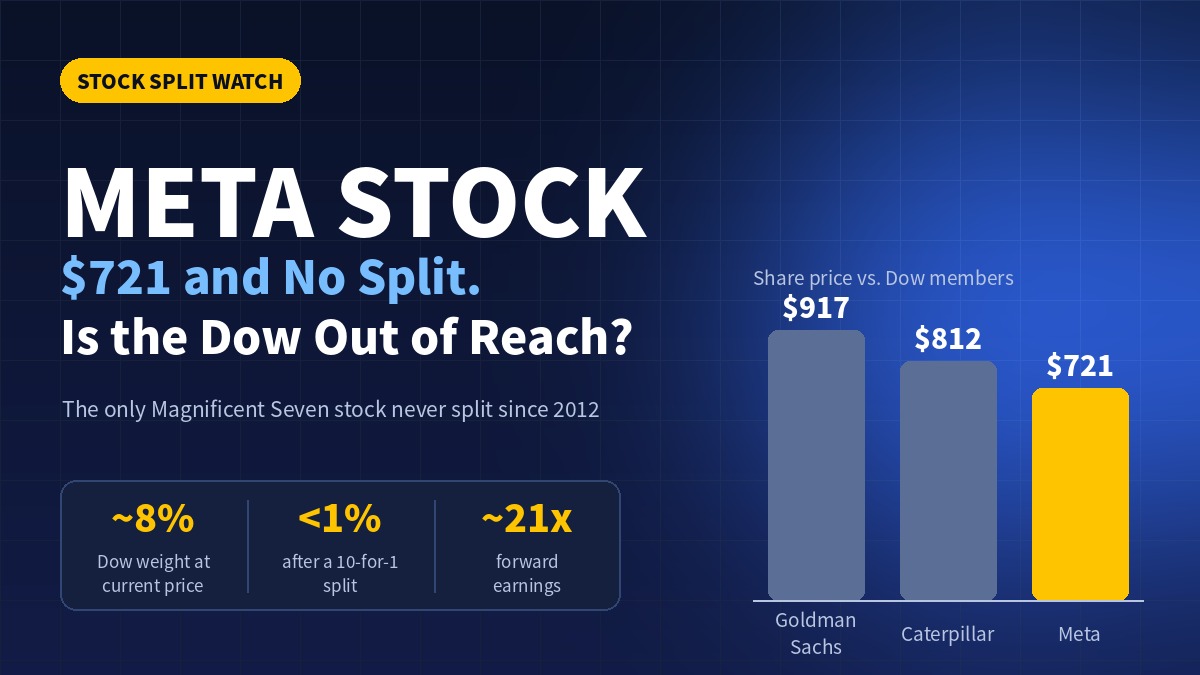
Meta Platforms is the priciest Magnificent Seven stock on a per-share basis, trading at about $721 as of the original report. It is also the only member of the group that has never split its shares since going public in 2012. That combination has revived a familiar question: would a split open the door to the Dow Jones Industrial Average?
The price gap is wide. Meta stock costs roughly 40% more per share than Microsoft, the next-priced member of the group, and more than three times as much as Nvidia. Shares reached a record close of $790 in August 2025, and no split followed.
Meta has given no signal that one is coming. The original analysis also argues that the Dow case for a split is weaker than it first appears, because of how the index is built and because another company just took the seat Meta would most naturally fill.
Why the Dow Question Keeps Coming Up
The Dow is price-weighted. A company’s influence on the index depends on its share price, not its size. A 1% move in a $900 stock shifts the index as much as a 10% move in a $90 stock. That is why high-priced tech companies have often split their shares before joining, and Amazon and Nvidia both did.
Quote data shown with the original report had Meta stock down 4.79% on the session, the Dow down 0.67%, and Alphabet down 0.34%.
The Split-Then-Join Pattern
| Company | Split | Close on announcement day | Announced | Joined the Dow |
|---|---|---|---|---|
| Amazon | 20-for-1 | $2,785.58 | March 2022 | February 2024 |
| Nvidia | 10-for-1 | $949.50 | May 2024 | November 2024 |
| Alphabet | 20-for-1 | Not stated in source | 2022 | June of this year |
Meta’s Price Already Fits the Index
Current Members Trade in the Same Range
Meta’s share price is not out of line with the Dow as it stands today. Goldman Sachs trades around $917 and Caterpillar near $812, and both are already members.
What a Split Would Do to Meta’s Weight
By the original analysis’s math, Meta at its current price would make up about 8% of the index if it replaced the lowest-priced member. That would be the third-largest weight, behind Goldman Sachs and Caterpillar. A 10-for-1 split would probably push Meta’s weight below 1%.
The Verizon Precedent
A weight that small can also be a problem. When S&P Dow Jones Indices, the index provider, dropped Verizon Communications in June, it noted that Verizon made up only around half a percentage point of the index because of its low stock price.
The Communication Services Seat Went to Alphabet
The bigger obstacle may be timing. When S&P Dow Jones Indices added Alphabet in place of Verizon, it said Alphabet would be a more representative communication services member of the index. Meta sits in the same sector.
Alphabet now joins Nvidia, Amazon, Apple, and Microsoft in the Dow. That leaves Meta and Tesla as the only Magnificent Seven companies outside the index.
What a Split Would Actually Change
A split does not change what a company is worth. It only divides each share into more pieces. Under a 10-for-1 split at today’s price, one $721 share would become 10 shares worth about $72 each. Meta’s second-quarter earnings per share of $6.18 would become roughly $0.62, and the stock would still trade at about 21 times forward earnings.
Companies often present splits as a way to make shares easier to own. Nvidia said its 2024 split was meant to make stock ownership more accessible to employees and investors.
Meta’s Closest Brush With a Split
In 2016, shareholders approved a plan to pay a dividend of two new nonvoting Class C shares for every existing share. That would have tripled the share count, much like a 3-for-1 split. The board scrapped the plan in September 2017.
Pricing Now Drives More of Meta’s Ad Growth
Meta’s value still rests on its advertising business, where pricing has been strengthening while impression growth has cooled.
| Metric (year over year) | Q4 2025 | Q1 | Q2 |
|---|---|---|---|
| Average price per ad | +6% | +12% | +12% |
| Ad impressions | Not stated in source | +19% | +14% |
The 12% gain in average price per ad in the second quarter matched the first quarter’s pace and doubled the 6% increase from the last three months of 2025. With impression growth slowing from 19% to 14%, more of Meta’s growth is now coming from pricing. Together, the two drove second-quarter revenue up 28% year over year to $60.8 billion.
Outlook: A Split Looks Unlikely for Now
The original analysis doubts that Meta will split its stock soon and does not see Dow inclusion as a strong reason to do so. At around 21 times forward earnings, it views Meta stock as reasonably priced for a company growing this quickly, and a split would not change that valuation.
Disclaimer: This content was partially produced with the help of AI tools and This content is for informational purposes only and not investment advice.