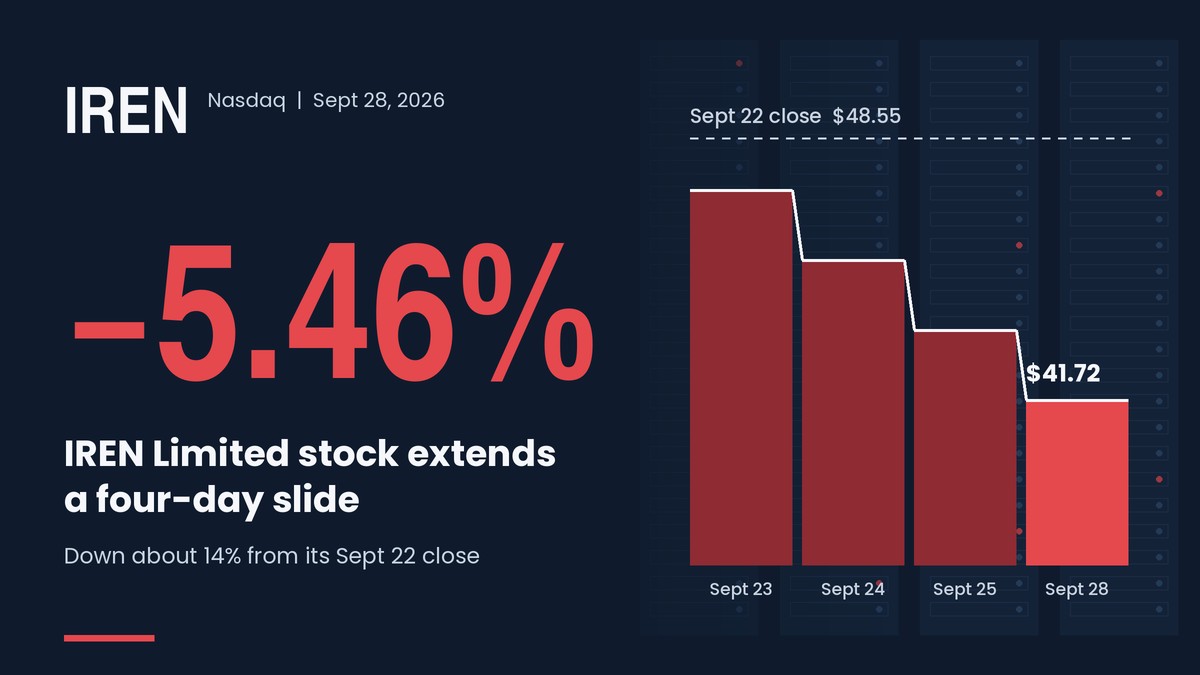
IREN Limited stock fell 5.46% on Monday, September 28, 2026, closing at $41.72 after opening the week at $44.13. It was the fourth straight losing session for the AI cloud operator, and it came as a run of cautious new analyst ratings and sector-wide worries about GPU pricing weighed on the group of so-called neocloud companies.
The losses add up quickly. The stock closed at $48.55 on Tuesday, September 22, which means it has shed about 14% in four trading days. On Monday alone, shares swung between a low of $41.70 and a high of $43.99, with roughly 26 million shares changing hands for a total value near $1.09 billion.
What happens next may hinge less on the chart and more on execution. IREN is in the middle of converting its business from bitcoin mining to AI cloud services, and the next few months will show whether new capacity comes online on schedule.
What drove the four-day decline
A wave of cautious coverage
The selloff followed several neutral initiations. Rothschild & Co Redburn analyst Alexander Haissl started coverage at Neutral with a $40 target on September 21, 2026, a notably softer view than the Sell ratings he put on CoreWeave and Nebius Group. Days later, Jones initiated IREN with a Hold on September 25.
Not every firm turned cautious. According to the original report, BTIG kept its Buy rating on IREN on September 14.
| Firm | Date (2026) | Action | Target |
|---|---|---|---|
| BTIG | Sept 2 | Target maintained | $80 |
| BTIG | Sept 14 | Buy rating maintained | Not stated |
| Rothschild & Co Redburn | Sept 21 | Initiated at Neutral | $40 |
| Jones | Sept 25 | Initiated at Hold | Not stated |
Pressure across the neocloud group
IREN was not falling alone. CoreWeave, Nebius, and IREN all declined on September 21 amid concerns over GPU pricing, a theme that has made investors more sensitive to how these companies finance hardware and price their computing capacity.
The trading picture by the numbers
| Session | Close | Change | Notes |
|---|---|---|---|
| Tue, Sept 22 | $48.55 | Up 2.79% | Recent top; fifth straight gain |
| Fri, Sept 25 | $44.13 | Down 4.38% | About 41.1 million shares traded |
| Mon, Sept 28 | $41.72 | Down 5.46% | About 26 million shares traded |
Trading volume dropped by about 14 million shares on Monday even as the price fell. Some technical analysts read lighter volume on a down day as a sign that selling pressure is not intensifying. Early after-hours data showed a modest bounce, with shares up $0.21 in extended trading, though after-hours moves are preliminary and often reverse.
Technical levels traders are watching
The original technical analysis flags accumulated-volume support at $40.20, a level that sits just above Rothschild’s $40 target. On the upside, it identifies resistance at $42.71 and $45.93.
Signals are mixed. A buy signal remains in place from the three-month MACD, while both short- and long-term moving averages point to sell signals. A sell signal was also triggered by the September 22 pivot top. The same analysis classifies the stock as high risk, noting average daily volatility of 5.56% over the past week.
How to read the model projections
The report’s trend model projects an 11.40% gain over three months, with a 90% probability range of $36.37 to $54.44. That wide band is a statistical output, not a price target. The same report downgraded its short-term conclusion from Hold to Strong Sell, citing weaknesses in the technical picture.
The business behind the volatility
The price swings reflect a company in transition. On its latest earnings call, IREN reported a quarterly net loss of $684 million, driven largely by $450.4 million in non-cash impairments tied mainly to decommissioning mining hardware. Management said it expects mining operations to be effectively wound down by the end of December 2026.
The AI cloud side is growing fast. The company said annualized run-rate revenue reached about $1 billion after Microsoft accepted its Horizon 1 deployment, and IREN has reported roughly $4 billion of contracted run-rate revenue for 2026 capacity, which it described as largely sold out.
Why the December quarter matters
Horizons 2 through 4 are targeted for the December quarter and are seen as the first real test of whether that contracted revenue turns into operating revenue. CEO Daniel Roberts has framed the challenge plainly: “Signing deals is not the bottleneck in this market, bringing GPUs online is.”
Even after the recent slide, the stock’s longer view is mixed. As of the September 25 close, shares were up 16.84% for the year but 42.25% below their highest close of the past 12 months.
Disclaimer: This content was partially produced with the help of AI tools and This content is for informational purposes only and not investment advice.