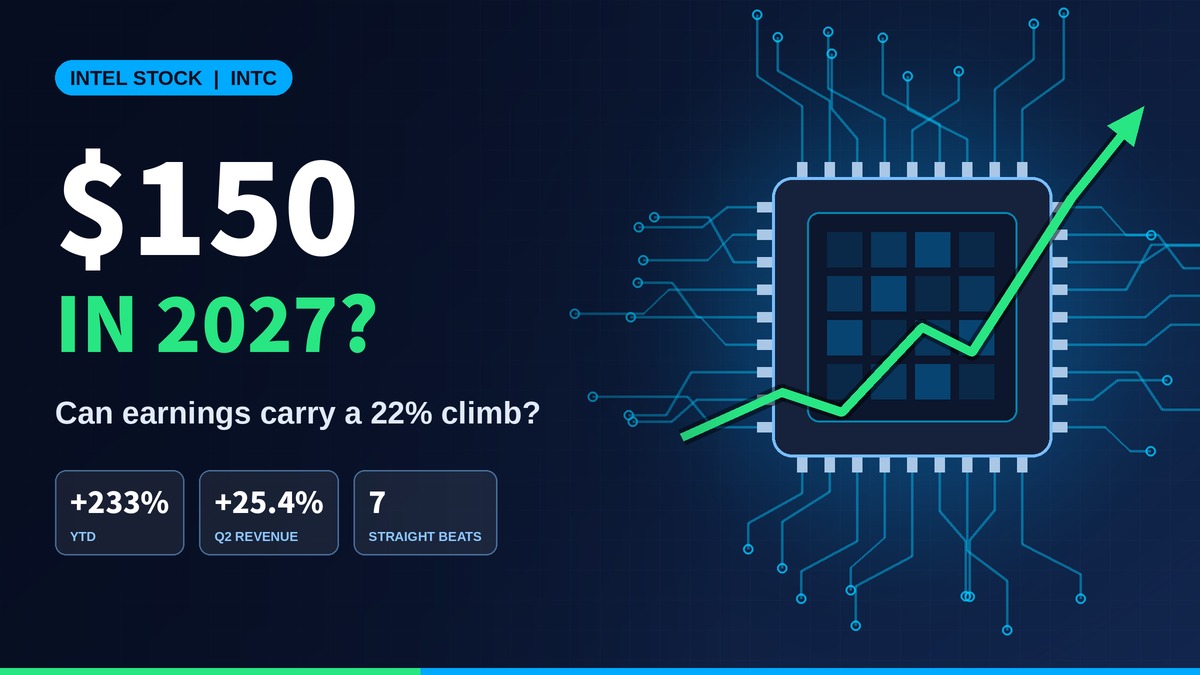
Intel has become one of the market’s most dramatic comebacks this year, and its second-quarter report gave the rally something concrete to stand on. Revenue reached $16.13 billion, up 25.4% from a year earlier. CEO Lip-Bu Tan called it “our strongest revenue growth in more than fifteen years, enabled by greater speed, accountability, and customer focus.”
The share price has moved even faster than sales. Intel stock has gained 233.33% year to date to about $123, based on figures in the source analysis. Reaching $150 by 2027 would take roughly another 22%.
Whether that happens depends on earnings more than sentiment. Analysts are raising profit forecasts quickly, but their average price target still sits below the current share price. The $150 debate comes down to the gap between those two signals.
The Valuation Math Behind a $150 Price
The simplest way to test the target is to compare it with expected 2027 earnings. The consensus 2027 EPS estimate is $2.0621, and the most bullish analyst projects $3.44.
| Scenario | 2027 EPS Estimate | Share Price | Implied P/E |
|---|---|---|---|
| Consensus, current price | $2.0621 | $123 | About 60x |
| Consensus, target price | $2.0621 | $150 | About 73x |
| Most bullish estimate, target price | $3.44 | $150 | About 44x |
For comparison, the S&P 500 trades at roughly 21 to 23 times forward earnings. At consensus numbers, a $150 share price would put Intel at more than three times the market multiple. If results land near the top of the estimate range, the valuation looks much less stretched.
Why the High-End Estimate Is in Play
Intel has now topped expectations for seven straight quarters. In Q2, non-GAAP EPS came in at $0.42, nearly double the $0.2175 analysts expected. That track record is the main argument that results closer to the bullish $3.44 figure are realistic rather than wishful.
Analysts Are Raising Forecasts Faster Than Targets
Wall Street’s view of Intel is split between its models and its ratings.
On the ratings side, sentiment is cautious. The consensus price target of $116.37 sits about 5% below the current price. Of the analysts covering the stock, 32 rate it Hold, 13 rate it Buy, and 1 rates it Strong Buy.
The earnings estimates point the other way. Consensus 2027 EPS has climbed to $2.0621 from $1.5245 just 90 days earlier, an upward revision of roughly 35%. Analysts now expect 2027 revenue of $72 billion, about 14% above the 2026 estimate, with EPS growth of roughly 36%. If revisions keep coming at that pace, price targets may eventually have to follow.
What Is Driving Intel’s Business Right Now
Data Center Demand Is Outrunning Supply
The strongest segment is Data Center and AI, where revenue rose 59% and operating profit reached 40% of revenue. Management said server CPU demand “continues to far outpace available supply.” It also described Xeon 6 as “one of the fastest ramping products in Intel history.”
Manufacturing Milestones: 18A and 14A
Output on the Intel 18A process came in approximately 25% above target. Looking further out, Intel 14A risk production remains on track for the second half of 2027, which lines up with the timeframe of the $150 thesis.
Custom Chips and Outside Investors
| Growth Area | Latest Figure | What Management Expects |
|---|---|---|
| Custom chip business | Nearing a $2 billion run rate | $4 billion soon, in a market sized at over $100 billion |
| NVIDIA partnership | $5 billion equity investment | Xeon 6 selected for DGX Rubin NVL8 systems |
| SoftBank | $2 billion investment | Not specified |
| Foundry losses | Narrowed by $348 million from the prior quarter | Continued improvement needed |
The Risks That Could Stall Intel Stock
The foundry remains a heavy drag. Intel Foundry lost $2.1 billion last quarter, even after the sequential improvement. Management also expects 2027 capital spending to be “significantly above the 2026 levels,” which could pressure cash flow while new capacity comes online.
Volatility is another factor. With a beta of 2.231, Intel stock tends to swing more than twice as much as the broader market, in both directions. And with most analysts rating the shares Hold, the market’s professional coverage has not fully bought into the turnaround.
A Reminder From 2023
Intel has made big moves before that did not last. In 2023, shares rose roughly 90% and then gave the gain back. On the other hand, the stock has traded as high as $142.35 within the past 52 weeks, not far below the $150 mark, so the target is within the range investors have already paid.
What Would Need to Go Right
A 22% gain is modest next to this year’s run, but it rests on several conditions holding at once. Intel would need to keep beating estimates, keep 18A ramping, scale its custom chip business toward the $4 billion level management expects, and continue narrowing foundry losses while spending more on capacity. If earnings rise toward the high end of forecasts, $150 looks supportable on valuation. If they settle near consensus, the stock would be priced well ahead of its profits, leaving little room for a stumble.
Disclaimer: This content was partially produced with the help of AI tools and This content is for informational purposes only and not investment advice.