Intel’s latest quarterly filing, covering the quarter ended June 27, 2026, shows that the production contract for its Arizona manufacturing venture took effect in the first quarter. The contract carries conditions that matter for anyone following Intel stock: if the company falls short of minimum production levels, or holds more inventory on site than the agreed limits allow, it can owe volume-related damages to the venture.
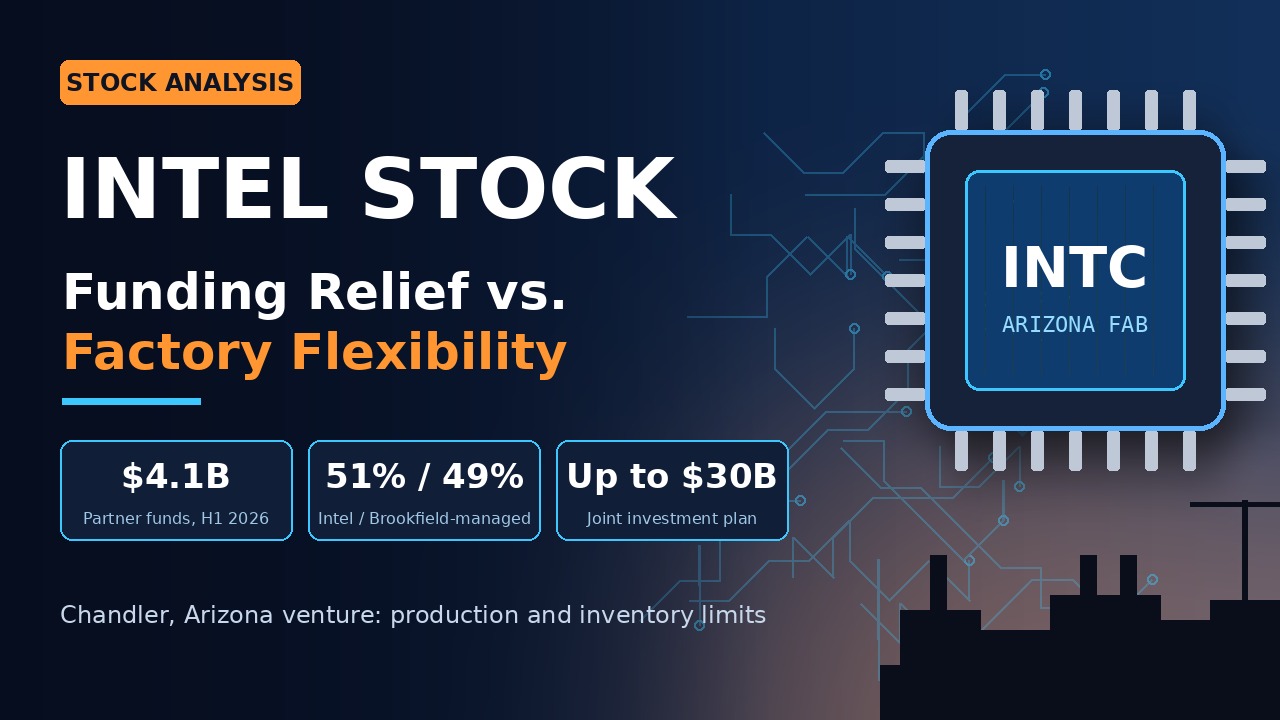
The venture dates to 2022, when Intel became its 51% owner and a Brookfield-managed investor took the remaining 49%. The original announcement outlined up to $30 billion of joint investment in two factories in Chandler, Arizona. In the first half of 2026, the venture recorded approximately $4.1 billion in partner contributions.
The arrangement is a tradeoff. Intel gets help paying for new capacity, but the bar is now higher than keeping equipment running. Production has to turn into sales without tying up too much cash in chips customers don’t want.
| Detail | As disclosed |
|---|---|
| Venture formed | 2022 |
| Ownership | Intel 51%, Brookfield-managed investor 49% |
| Planned joint investment | Up to $30 billion |
| Facilities | Two factories in Chandler, Arizona |
| Partner contributions, first half of 2026 | About $4.1 billion |
| Production contract start | First quarter of 2026 |
| Filing period | Quarter ended June 27, 2026 |
What the Production Contract Requires
Two ways to trigger damages
The filing describes two conditions. Output below the minimum production level can lead to volume-related damages, and so can inventory on site above the set ceiling. Together they limit Intel’s options in both directions: it can’t simply cut output, and it can’t simply build up stock.
What the filing doesn’t say
The quarterly note does not quantify the minimum production threshold, the inventory ceiling, or the formula for calculating damages. Without those terms, investors can’t reliably estimate how costly a demand shortfall would be.
The Case for the Deal
Outside capital without giving up control
The structure gave Intel access to outside capital while keeping operational control. When the deal was announced, management said it would protect the company’s cash and borrowing capacity. Sharing construction costs can free up resources for product development and other investments that compete for the same dollars. The roughly $4.1 billion in partner contributions recorded in the first half of 2026 shows the funding benefit is real.
Demand makes the commitments lighter
Sustained demand would make the production commitments easier to meet. Higher utilization spreads factory costs across more saleable chips, and Intel keeps the right to buy all of the venture’s wafer output. If customers take that output at attractive margins, the arrangement supports manufacturing capacity that would otherwise require substantially more funding from Intel alone. When commercial demand already justifies the required production, the operating limits matter much less.
The Risks for Intel Stock Investors
Weak orders shrink the room to adjust
The math gets harder if orders disappoint. Cutting production could carry contractual consequences. Continuing to make chips that aren’t selling could tie up working capital and raise exposure to discounting or obsolescence. Because of the inventory condition, producing more is not a free fallback either.
The partner shares in the upside
The investor also participates in the venture’s economics. Paying a smaller share of construction costs means giving up a claim on future returns.
How the money moves
Intel consolidates the venture’s results, and any damages are paid to the venture itself. Investors in Intel stock will need to track how such payments affect distributions to the partner and the cash Intel ultimately keeps.
Hedge Fund Positioning
According to Insider Monkey’s database, 138 hedge funds held Intel at the end of the second quarter of 2026, up from 122 funds three months earlier. The filings available so far reflect positions taken before Intel reported its second-quarter 2026 results.
What to Watch Next
Intel gave up some operating flexibility in exchange for significant funding support. The trade looks reasonable if the Arizona factories consistently produce chips customers want at profitable prices, and it becomes a burden if production commitments outrun demand.
Four indicators will show which way it goes: factory utilization, inventory turnover, partner distributions, and any volume-related payments Intel discloses.
Disclaimer: This content was partially produced with the help of AI tools and This content is for informational purposes only and not investment advice.