
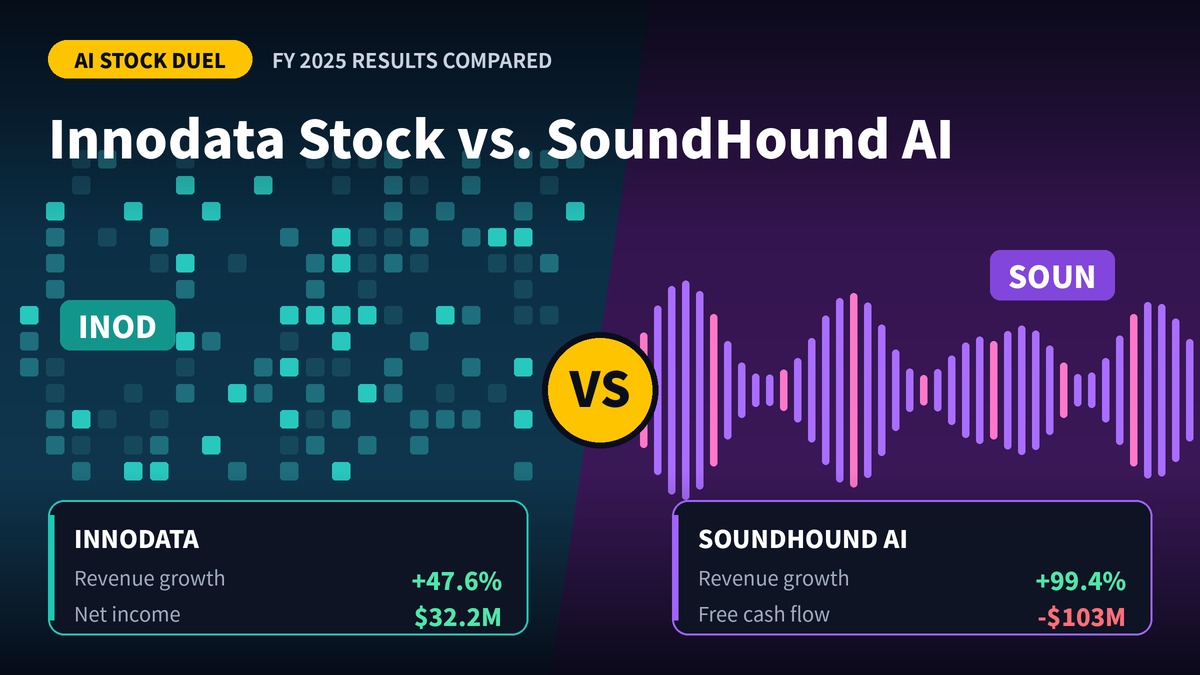
Innodata stock and SoundHound AI offer investors two very different routes into artificial intelligence, and their most recent full-year results show just how far apart those routes are. One company is already profitable and generating cash. The other is growing faster but still spending heavily to build scale.
The gap is clearest in the bottom line. Innodata reported net income of roughly $32.2 million for fiscal 2025, while SoundHound posted a net loss of about $14.0 million and negative free cash flow of around $103 million over the same period.
What happens next depends on different pressures for each. Innodata’s biggest question is how much of its business rests on a single client, and SoundHound’s is whether its expansion into enterprise messaging through LivePerson can pay off without further straining its cash.
Two Ends of the AI Supply Chain
The two companies sit at opposite stages of how AI products are built and delivered. Innodata works upstream, supplying the data engineering and human expertise used to train and evaluate large language models. SoundHound works downstream, building the voice and conversational interfaces that consumers actually talk to in cars, restaurants and customer service lines.
That distinction shapes their financial profiles. Data services for model builders have produced steady profits for Innodata, while SoundHound’s platform business requires large upfront investment before revenue catches up.
Fiscal 2025 Results Side by Side
| Metric (FY 2025) | Innodata (INOD) | SoundHound AI (SOUN) |
|---|---|---|
| Revenue | ~$252 million | $168.9 million |
| Revenue growth | 47.6% | 99.4% |
| Net income (loss) | ~$32.2 million | ~($14.0 million) |
| Free cash flow | ~$35.6 million | ~($103 million) |
| Current ratio | 2.7x | ~4.6x |
| Debt-to-equity | 0.0x | 0.0x |
Figures are drawn from each company’s fiscal 2025 annual results and December 2025 balance sheets, as reported in the source analysis.
What Drives Innodata Stock
A Profitable Growth Story
Innodata’s revenue climbed 47.6% to nearly $252 million, and net income rose from about $28.7 million in 2024 to roughly $32.2 million. That works out to a net margin of close to 13%, which is unusual among smaller AI names. The company’s clients include five of the so-called Magnificent Seven tech giants along with frontier AI research labs.
The Concentration Problem
The strongest argument against Innodata stock is dependence on one relationship. A single customer in the company’s Digital Data Solutions segment accounted for about 58% of total revenue in 2025. If that client scaled back spending or brought data work in-house, the impact on results would be significant.
A Closer Look at Cash Flow Quality
Innodata generated roughly $35.6 million in free cash flow, but stock-based compensation made up about 23.8% of operating cash flow. Because SBC is a non-cash expense added back in the cash flow statement, it flatters reported cash generation while diluting shareholders over time.
What Drives SoundHound AI
Faster Growth, Narrower Losses
SoundHound nearly doubled revenue to $168.9 million in 2025. Its net loss of about $14.0 million was a sharp improvement from prior years, and the company’s OASYS platform now handles billions of conversations annually for automakers and restaurant chains.
The LivePerson Deal
SoundHound’s biggest recent move is its purchase of LivePerson. SoundHound agreed to buy the company for an implied enterprise value of $250 million and an equity value of $43 million, in an all-stock transaction. LivePerson’s platform processes around 1 billion customer messages each month, and the combined company will serve customers in more than 30 countries.
The source analysis reports the acquisition was completed in September 2026. Earlier coverage said the deal was expected to close in the second half of 2026, pending regulatory approval, so readers should check SoundHound’s investor filings for final closing details.
Why Some Investors Are Cautious
The deal adds scale but also losses. Reports noted LivePerson’s net loss of $134.2 million in 2024 and $67.2 million in 2025. On the other side, SoundHound projects 2027 revenue of at least $350 million to $400 million, with LivePerson contributing about $100 million. SoundHound also said it expects to operate the combined firm with no debt.
How the Balance Sheets Compare
Neither company carries meaningful debt, with both reporting a debt-to-equity ratio of 0.0x. SoundHound holds the stronger short-term liquidity at a current ratio near 4.6x versus Innodata’s 2.7x. That cushion matters because SoundHound is burning cash, while Innodata funds its operations internally.
For investors weighing Innodata stock against SoundHound, the choice comes down to risk profile. Innodata offers current profitability paired with heavy customer concentration. SoundHound offers faster top-line growth paired with cash burn and integration risk from a large acquisition.
Disclaimer: This content was partially produced with the help of AI tools and This content is for informational purposes only and not investment advice.