
Fire Emblem: Fortune’s Weave has arrived on Switch 2 as the series’ biggest experiment yet, stretching a single campaign across three full acts and four playable lords whose pasts the player must rewrite to save the world from ruin. It matters now because it marks a clear turning point for the franchise: after years of expanding scope through Fates, Three Houses, and Engage, Fortune’s Weave commits fully to a maximalist structure rather than easing into one.
That commitment shows up most clearly in the numbers. Reaching the credits took more than 130 hours, and even at that length, entire scenes, support conversations, and side events were left unseen, a scale that puts Fortune’s Weave closer to a trilogy than a single strategy title.
The broader story here is less about mechanics and more about ambition. Fortune’s Weave asks whether packing nearly every idea the series has tried into one release makes for a richer experience or simply a heavier one, and the answer, at least in this telling, lands somewhere in between: a game defined as much by what it demands from players as by what it gives back.
A Time-Bending Structure Built Around Four Fallen Lords
The campaign opens at the end of the world. A player-created avatar known as the Pale Raven survives an apocalypse alongside Fortuna, a goddess of fate, after nearly everyone else has fallen to the encroaching lord of the underworld, Balor. To have any chance of stopping him, the two retreat to a chamber outside of time and travel back to the lives of four Flame Lords of Dagda, each of whom has gathered in the capital of Dagsion for the Heroic Games, a tournament where Divine Emperor Solel has promised to grant the victor any wish.
The four lords and what drives them
Each lord’s route unfolds as its own campaign within the larger game, and correcting the events that led to their deaths in the original timeline lets them rejoin the fight against Balor later on.
| Lord | Core Motivation | Signature Mechanic |
|---|---|---|
| Cai | Rescue his father from execution | Mounted magic training path |
| Theodora | Reclaim land for her people | Battalion recruitment |
| Leda | Avenge her father’s death | Tavern performances |
| Dietrich | Fight for the love of battle | Shadowstep Blaze Art |
Storylines that fold back into each other
None of the four routes are mandatory on their own, since the final fight against Balor can technically be attempted with just one lord in tow. But the routes reward each other: moments referenced in passing during Cai’s story, such as an aside between Dietrich and his spellcasting companion Fabio, later play out in full once that lord’s own path is reached, giving the overlapping structure genuine payoff rather than repetition for its own sake.
Where Fortune’s Weave Is At Its Best
Coliseum battles and combat depth
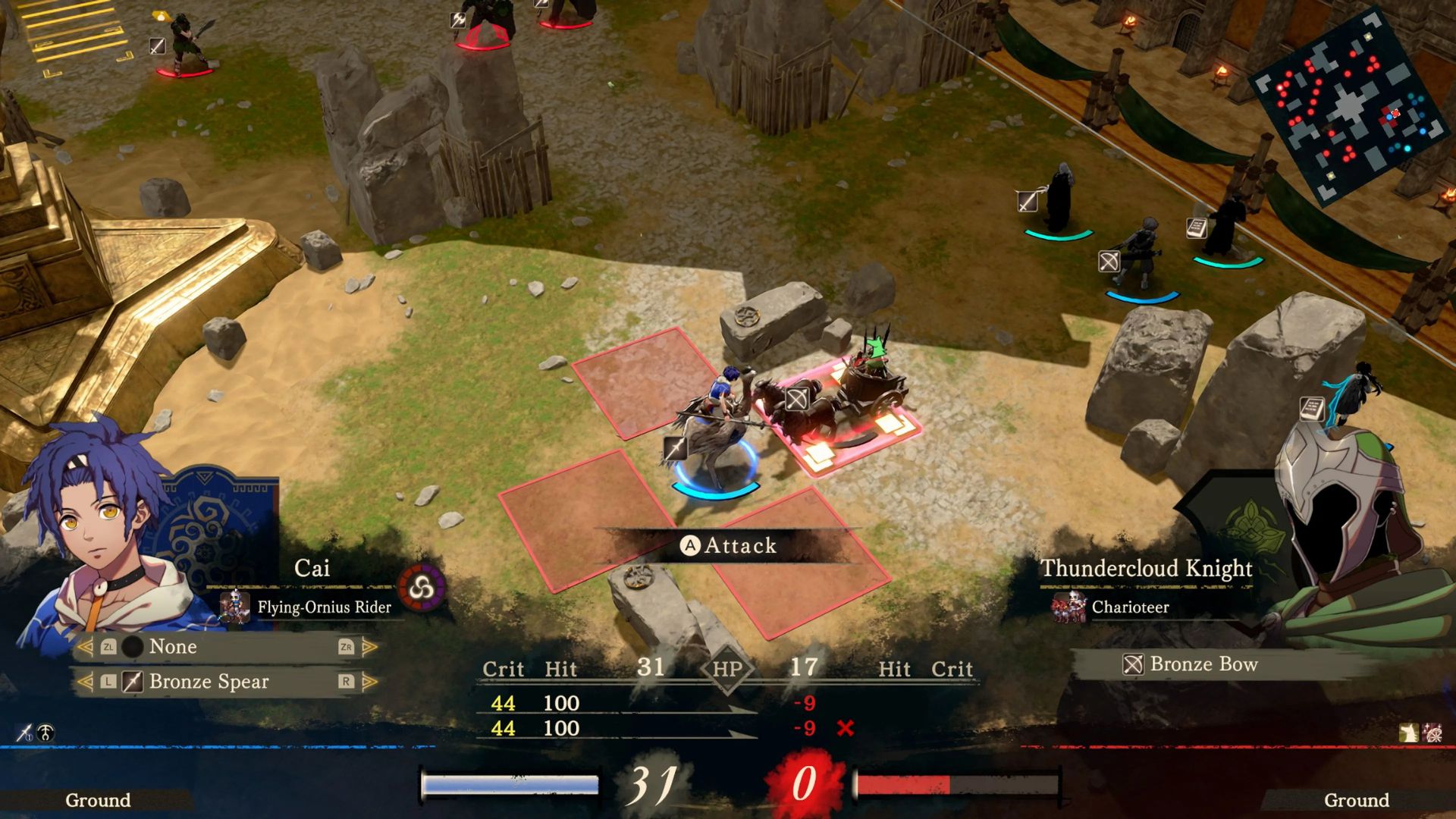
The strategy layer is strongest in its set-piece fights, particularly the tournament battles staged in Dagsion’s arena. Developer Intelligent Systems builds these coliseum maps around charging chariots, environmental puzzles, and combat arenas tailored to push specific unit compositions, giving the Heroic Games a theatrical identity that overworld skirmishes generally lack.
Fortune’s Weave also drops the traditional weapon triangle in favor of letting weapon types excel against specific unit categories, such as magic countering armor or lances countering mounted units. Combined with a deeper Combat Arts system and lord-exclusive Blaze Arts, like Leda’s spellsongs, the combat gives experienced tacticians real room to specialize units toward distinct roles.
Where the Scope Becomes a Burden
Dungeon crawling and free time management
The game’s more RPG-inflected dungeon exploration, a mechanic carried over from Echoes: Shadows of Valentia, wears thin quickly. Encounters within dungeons rely on the same strike-to-engage formula throughout, and by the end of the first lord’s route, auto-battling becomes the more practical option rather than manually working through repeated fights.
Free time between battles follows a similar pattern. Balancing support conversations, resource gathering, training, and paralogue deadlines can create real tension when a deadline looms, but across a 130-hour campaign, those systems increasingly settle into a routine of training, eating, and running automated activities rather than meaningful choices.
Three acts is a lot to ask
Completing a single lord’s arc unlocks a second chapter following that lord’s story into a war shortly after the Heroic Games conclude, and only after that does the lord become available for the final campaign against Balor, which layers its own day-cycle systems on top. Quality-of-life additions, including progression carried over between paths and the ability to auto-clear previously finished side content, help offset the load, but the total time investment remains substantial.
The story beneath the systems
What sustains the game through its length is its writing. Fortune’s Weave repeatedly returns to questions of mortality and legacy, including how communities decide what is worth recording, defending, or passing down. Theodora’s route, for instance, explores tension around a religious prohibition on writing down history, while Leda’s storyline weighs the cost of pursuing revenge against what she stands to lose along the way.
Supporting cast members such as Fabio, Mu, Anatolia, and Talimun add further texture through banter and battlefield moments, giving the world a lived-in quality that helps justify the time commitment the game asks for.