
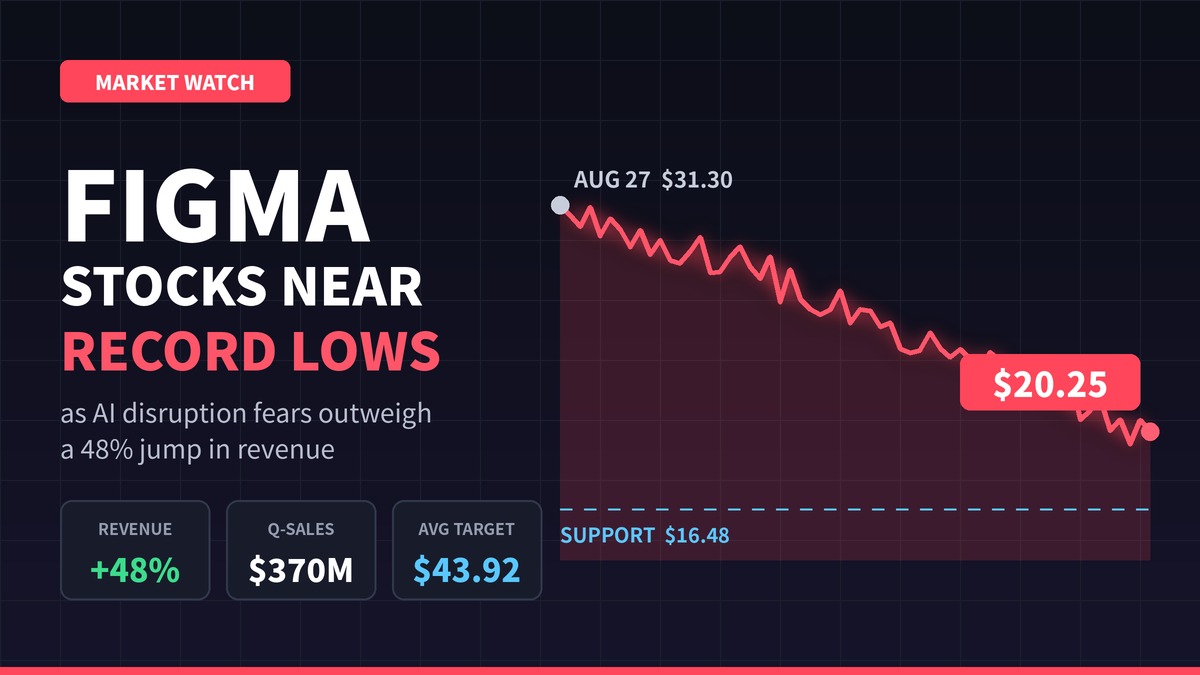
Figma stocks have given back most of their late-summer rebound, falling to about $20.25 after touching $31.30 on August 27. The decline puts the design software company close to its all-time low, and it comes at an awkward moment: investors are selling on fears that AI tools will erode demand for Figma’s product just as the company reports some of its strongest operating numbers since going public.
The most striking figure is revenue. Figma’s latest quarterly sales rose 48% to $370 million, beating both the company’s own guidance and Wall Street’s expectations. Paid customer counts and AI usage also climbed during the period.
That gap between a falling share price and a growing business is now the central question for shareholders. Analysts remain broadly optimistic, while the technical picture suggests the selling may not be finished.
Why investors are worried
Figma runs a collaborative platform where teams design, prototype, and hand off digital products such as websites and mobile apps. That workflow is exactly where generative AI has made fast progress. General-purpose assistants like Claude and ChatGPT can now produce design concepts and working prototypes from plain-language prompts, raising the question of whether some customers will need fewer Figma seats over time.
The market has priced that risk aggressively, even though the company’s reported results have not yet shown it.
What the latest results actually show
Customer growth
The revenue beat was driven by more paying customers and faster user adoption, particularly among larger accounts.
| Metric | Latest reported figure |
|---|---|
| Quarterly revenue | $370 million (up 48% year over year) |
| Customers paying over $10,000 in annual recurring revenue | 15,964 |
| Customers paying over $100,000 a year | 1,635 |
| Share of $10,000+ customers using AI credits weekly | More than 80% |
Turning AI into revenue
The last figure in that table may matter most. Figma has reworked its pricing to charge for AI features through a credit system, and more than four in five of its larger customers now draw on those credits every week. In other words, AI is currently showing up in Figma’s numbers as a source of revenue rather than a drain on it.
The company has also launched Code Layers, a feature meant to let teams move from idea to built product without leaving the platform. It is a direct attempt to capture more of the development process that AI tools are compressing.
What analysts expect next
Forecasts compiled by Yahoo Finance point to continued growth, though at a slower pace than the most recent quarter.
| Estimate | Consensus figure |
|---|---|
| Third-quarter revenue | $375.7 million (up 37%) |
| Full-year revenue, this year | $1.47 billion (up 40%) |
| Full-year revenue, next year | $1.82 billion |
| Earnings per share, this year | 29 cents |
Price targets sit well above where Figma stocks currently trade. The average analyst target is $43.92, more than double the recent price. Bank of America sees the shares reaching $33, while Citigroup raised its target from $35 to $37. Figma’s recent habit of beating its own guidance is one reason analysts have stayed constructive, although past outperformance does not guarantee future results.
What the chart is signaling
Momentum indicators
The near-term trend remains negative. The shares have fallen below their 50-day exponential moving average and continue to trade under the Supertrend indicator, a reading that technical analysts associate with sellers holding control. The Relative Strength Index has also kept sliding and is approaching 30, the level commonly treated as oversold.
Levels to watch
If the pressure continues, the next significant support sits at $16.48, the stock’s low in both April and June of this year. Technical traders often watch for buyers to step in near prior lows like this one, though a clean break below it would put the shares in new territory.
Background: from IPO surge to steep decline
Figma went public in July 2025 at $33 per share and briefly soared to around $142 in its first days of trading, one of the most dramatic debuts of that year. At roughly $20, Figma stocks now trade well below both that peak and the original IPO price, a reversal that reflects how sharply sentiment around AI’s impact on software has shifted.
Disclaimer: This content was partially produced with the help of AI tools and This content is for informational purposes only and not investment advice.