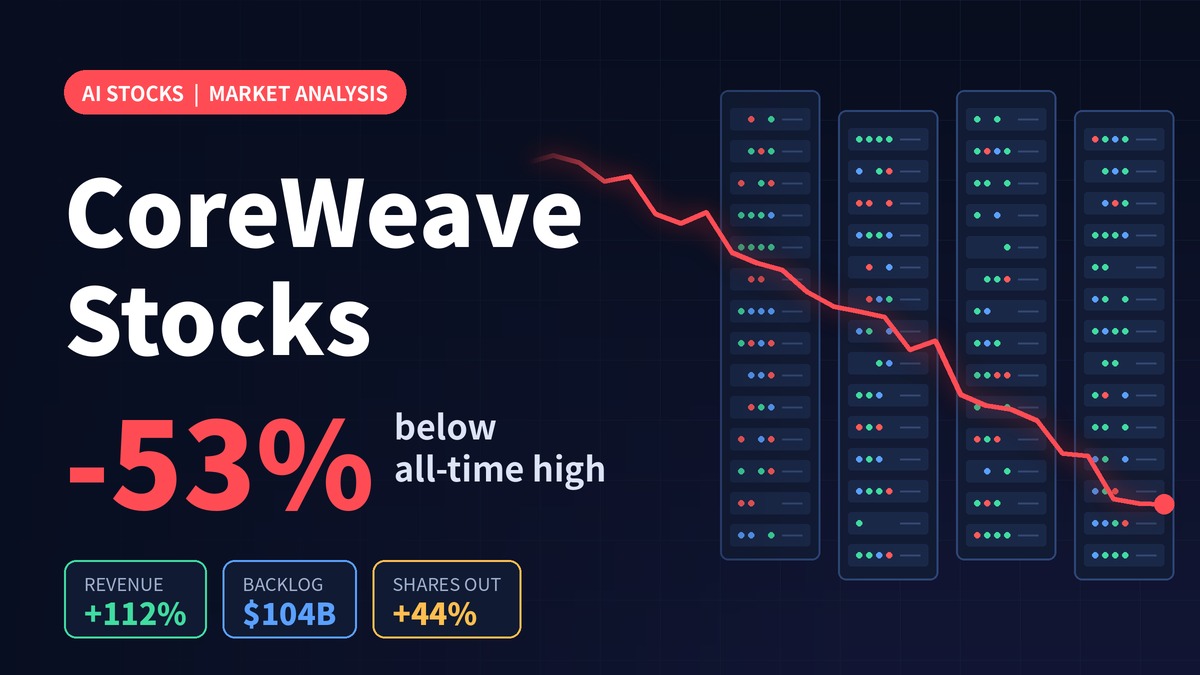
CoreWeave shares traded at $86.65 on Tuesday, less than half their all-time high, just weeks after the company posted the strongest quarter in its history. That leaves CoreWeave stocks 53% below their record. Investors are no longer questioning whether demand for AI computing power exists. They are questioning who will ultimately pay for it, and on what terms.
Rival neocloud Nebius is holding up better but hasn’t escaped the pressure. Its shares fell to $240, about 20% below this year’s high. Short interest in both companies remains above 10%, a sign that a meaningful share of the market is betting the declines have further to run.
The price action points to three concerns: the finances of the AI labs that make up much of these companies’ customer base, the debt-heavy model used to build data centers, and the steady issuance of new shares. Each affects how much of today’s growth ultimately reaches shareholders.
The growth numbers are not the problem
Operationally, both companies are expanding at a pace few public firms have matched. Nebius management has said it could sell out next year’s capacity today, which suggests supply, not demand, is the binding constraint.
| Metric | CoreWeave | Nebius |
|---|---|---|
| Latest quarterly revenue | $2.6 billion (Q2) | $582 million |
| Year-over-year growth | 112% | 454% |
| Other reported figures | $104 billion backlog | $981 million first-half revenue, up 529% |
| Spending outlook | $35 billion to $39 billion capex this year | Billions in ongoing data center spending |
CoreWeave’s $104 billion backlog makes it the largest player in the neocloud segment by contracted future revenue.
Background on the two companies
CoreWeave began as a cryptocurrency mining operation before pivoting to renting out Nvidia GPUs, and listed on Nasdaq in March 2025 at $40 per share. Its IPO filing showed Microsoft accounted for roughly 62% of its 2024 revenue, an early signal of the customer concentration that now worries investors. Nebius, headquartered in Amsterdam, emerged from the 2024 restructuring of Yandex N.V. after the Dutch parent sold off its Russian businesses.
Why investors are watching the customers
A growing list of prominent market voices, including Ray Dalio, Michael Burry, Jim Chanos and Patrick Boyle, have warned that AI spending may be running ahead of the revenue needed to justify it. For neoclouds, that warning lands directly on their order books.
Many of the frontier AI labs buying compute are deeply unprofitable. According to figures cited in the original report, Anthropic lost more than $42 billion last year, while OpenAI is losing over $12.3 billion per quarter and has told investors it expects to burn more than $280 billion through 2030.
Those same labs keep signing large infrastructure commitments. The report says Anthropic has agreed to a $45 billion deal with Nscale, $35 billion with Lambda, $10 billion with Volta, and a separate arrangement with SpaceX.
Competition could pressure lab economics
The model market is also getting more crowded. Meta Platforms’ Muse is reportedly gaining share, and Chinese open-weight models are drawing demand thanks to their performance and lower cost. If pricing power erodes for the leading labs, their ability to fund multiyear compute contracts could come under strain.
The financing model behind the buildout
Much of the capital for new data centers comes from GPU-backed financing arranged through special purpose vehicles. The companies pledge customer contracts and hardware as collateral, which lets them scale faster than cash flow alone would allow. It also creates specific vulnerabilities.
Three pressure points
The first is contract cancellation. If customers cut back to manage their own costs, the collateral backing the loans weakens.
The second is depreciation. Nvidia and its competitors now release new chip generations roughly every year, which can shorten the useful economic life of existing GPUs. Faster depreciation hits reported earnings and forces earlier reinvestment in newer hardware.
The third is timing. For the model to work, the debt has to be paid down faster than the chips lose value, and customer contracts have to outlast the loans. Rapid hardware turnover makes that balance difficult to maintain.
Dilution adds another layer
Shareholders are also absorbing new equity. Nebius sold 12.7 million shares through June, raising $2.8 billion, and has another 12.3 million shares available to issue. CoreWeave’s share count climbed to 457 million from 317 million a year earlier, an increase of roughly 44%. That means each share now represents a noticeably smaller claim on the company’s future profits, one reason CoreWeave stocks have lagged the company’s revenue growth.
What to watch from here
The next leg for CoreWeave stocks likely depends less on headline growth and more on the quality of that growth. Key signals include any contract revisions from major AI lab customers, the terms on new GPU financing, depreciation policy in upcoming filings, and further share issuance. Funding rounds at OpenAI, Anthropic and other labs also matter, since those dollars ultimately flow through to neocloud revenue.
Disclaimer: This content was partially produced with the help of AI tools and This content is for informational purposes only and not investment advice.