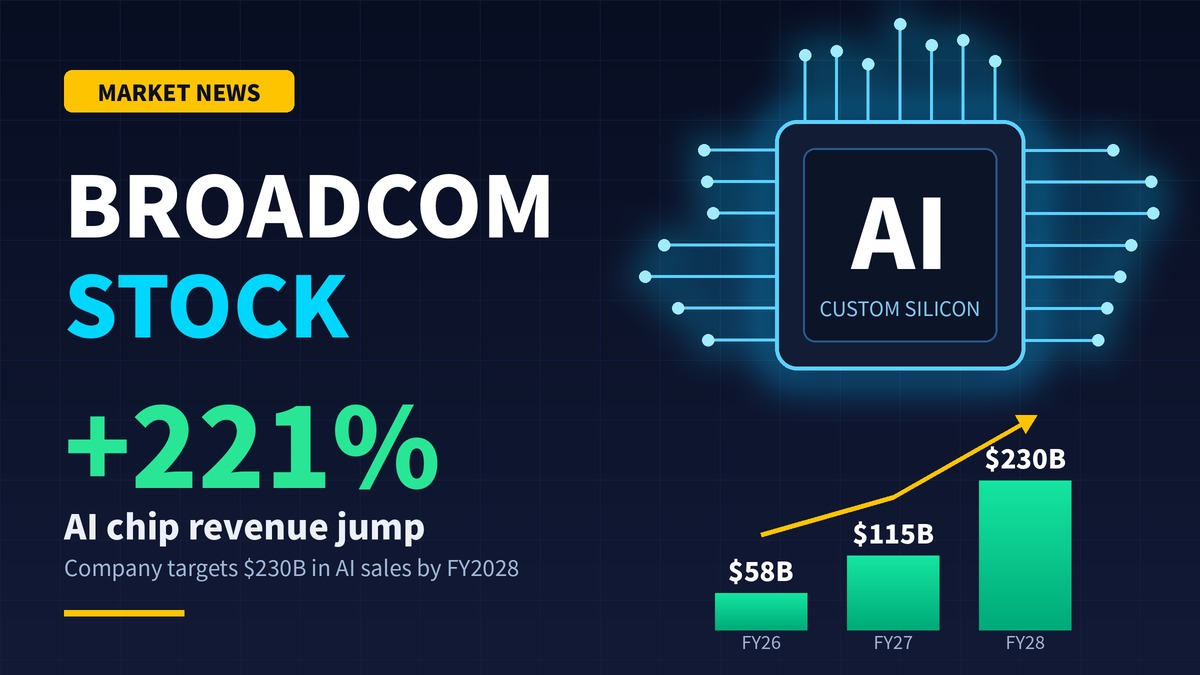
Broadcom’s artificial intelligence semiconductor revenue more than tripled in its fiscal third quarter, which ended Aug. 2, reaching $16.7 billion as large technology companies ramped up orders for custom-built AI processors. The results put Broadcom stock at the center of a broader change in how the biggest AI spenders buy computing power. Alongside off-the-shelf graphics chips, they are now buying more silicon designed for their own workloads.
The 221% year-over-year increase came mainly from custom accelerator shipments, which rose 3.5 times from a year earlier. Custom silicon made up nearly three-quarters of Broadcom’s AI revenue in the quarter, or roughly $12.5 billion.
Broadcom now expects about $58 billion in AI revenue for fiscal 2026, above its earlier $56 billion target. It has also issued forecasts that would roughly double that figure in each of the next two years. Those projections depend on a small group of customers following through on multiyear deployment plans.
Why Hyperscalers Are Turning to Custom Chips
Broadcom works in a different part of the AI chip market than Nvidia and AMD. Those two companies sell general-purpose GPUs and server CPUs that can train and run a wide range of AI models. Broadcom designs application-specific integrated circuits (ASICs), which are processors built for one customer’s specific models and software.
That tradeoff gives up flexibility in exchange for efficiency, and the savings are most visible in inference, the work of running trained models for users. Industry estimates cited in the original analysis suggest custom chips can cut inference costs by 40% to 60% compared with GPUs. For companies operating AI services at massive scale, a gap that size is a strong reason to build in-house silicon.
Six Core Customers
On its June earnings call, Broadcom said it has six core customers for custom AI chips. The publicly identified names include Alphabet’s Google, Meta Platforms, OpenAI, and Anthropic. Google’s Tensor Processing Units, developed with Broadcom, are the longest-running example of this kind of partnership.
The Forecast: From $58 Billion to $230 Billion
Broadcom’s outlook climbs steeply over the next two years. The reported figure is below, alongside the company’s guidance and longer-range projections.
| Period | AI revenue | Status |
|---|---|---|
| Q3 fiscal 2026 | $16.7 billion | Reported, up 221% year over year |
| Q4 fiscal 2026 | $21.7 billion | Company guidance, up 236% year over year |
| Fiscal 2026 | $58 billion | Company expectation, raised from $56 billion |
| Fiscal 2027 | $115 billion | Company forecast |
| Fiscal 2028 | $230 billion | Company forecast |
Broadcom has described demand from its AI customers as showing “exponential growth.” The company also says it has secured the manufacturing supply needed to support the targets.
Anthropic’s Deployment Schedule
The clearest example is Anthropic. Broadcom plans to deploy 1 gigawatt of custom AI chips for Anthropic in 2026, followed by 5 gigawatts in 2027 and 10 gigawatts in 2028. Broadcom also expects Google and OpenAI to speed up their own custom silicon deployments.
What Could Change the Outlook
The fiscal 2027 and 2028 figures are company projections, not reported results. With revenue concentrated among six customers, any change in a single customer’s data center spending or chip strategy could have an outsized effect on the numbers.
How Broadcom Compares With Nvidia and AMD
The three companies use different fiscal calendars, so the comparisons below are approximate. Nvidia’s fiscal year ends in late January, which means most of its fiscal 2027 overlaps with calendar 2026.
| Company | Recent figure | Annualized or forecast |
|---|---|---|
| AMD | $12.5 billion data center revenue, first half of 2026 | About $25 billion run rate |
| Broadcom | $58 billion expected AI revenue, fiscal 2026 | $230 billion forecast, fiscal 2028 |
| Nvidia | $164 billion data center revenue, first half of fiscal 2027 | About $330 billion run rate |
On these figures, Broadcom’s AI business is already more than twice the size of AMD’s data center segment. If Broadcom’s forecasts hold, it would become the second-largest AI chip supplier.
Nvidia remains far ahead. It earns more than 90% of its revenue from data center products. The original analysis projects that Nvidia’s data center revenue could exceed $800 billion in fiscal 2028 if expectations for roughly 70% top-line growth are met. Broadcom’s forecasts imply a faster growth rate, but from a much smaller base.
Valuation and Earnings Expectations
Analysts expect strong long-term earnings per share growth from all three companies. AMD is projected to grow fastest, followed by Broadcom and then Nvidia. At the time of the original analysis, Broadcom traded at about 19 times forward earnings, compared with 25 times for Nvidia and 39 times for AMD.
The original analysis argues that this combination of growth and a lower multiple makes Broadcom stock appealing relative to its peers. Forward multiples change with share prices and earnings estimates, however, so these comparisons reflect a single point in time.
Disclaimer: This content was partially produced with the help of AI tools and This content is for informational purposes only and not investment advice.