Berkshire Hathaway’s position in Alphabet stock now accounts for about 10% of the conglomerate’s entire equity portfolio as of Sept. 25, according to the original report. That is a remarkable concentration for a company that spent most of its history steering clear of technology. The milestone arrives days after a leadership change: Warren Buffett stepped down as chairman of Berkshire Hathaway and was named chairman emeritus, effective immediately.
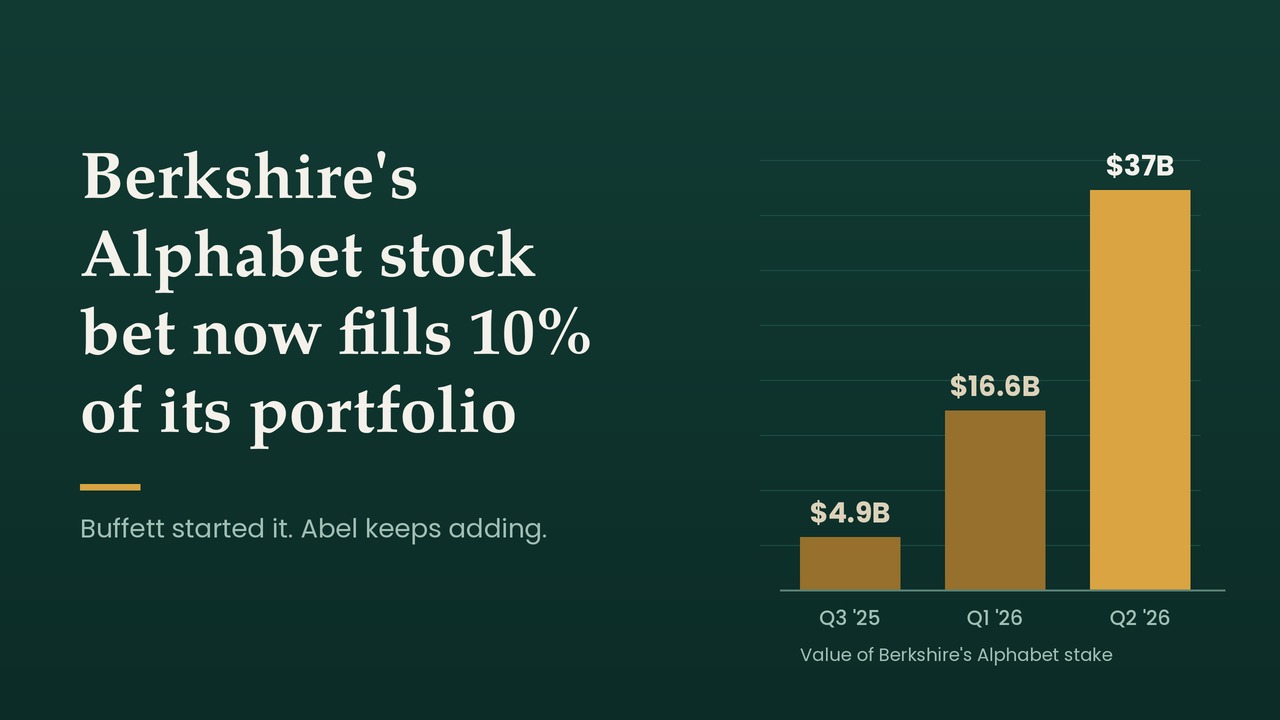
The stake grew fast this year. Berkshire increased its Alphabet holding by 83% in the second quarter, according to a 13F portfolio disclosure, bringing it to roughly 106 million shares worth about $37 billion, making it Berkshire’s third-largest stock holding behind only Apple and American Express.
What comes next rests with CEO Greg Abel, and with whether Alphabet’s enormous artificial intelligence spending earns the kind of returns Berkshire has historically demanded. Berkshire’s next quarterly 13F filing, due in mid-November, will show whether buying continued through the third quarter.
How a Tech Skeptic Built a $37 Billion Position
From first purchase to third-largest holding
| Period | Development |
|---|---|
| Q3 2025 | Berkshire disclosed 17.85 million Alphabet shares as of Sept. 30, valued at about $4.93 billion when revealed in November |
| Q1 2026 | Added 36.4 million Class A shares and opened a 3.6 million-share Class C position |
| March 31, 2026 | Held roughly 57.8 million shares, valued near $16.6 billion |
| Q2 2026 | Stake rose 83% to about 106 million shares |
| Sept. 25, 2026 | Alphabet represents about 10% of the portfolio, per the original report |
Open-market buying was only part of the story. Earlier this year, Berkshire also participated in a $10 billion private placement by Alphabet to help fund the company’s artificial intelligence infrastructure.
Buffett’s own account
For months, many investors assumed the position reflected Abel putting his own stamp on the portfolio. Buffett settled that in July. “I initiated it,” Buffett said in an interview with CNBC’s Becky Quick, while stressing that he and Abel talk constantly and that Abel has the final say.
His test for the company was about durability, not past performance. As he put it, “It’s the question, how long is it going to be wonderful?” He also tempered expectations somewhat, noting that there are still four or five other stocks in the Berkshire portfolio he considers superior businesses.
A long runway to the decision
Buffett was first drawn to the quality of Alphabet’s operations over a decade ago, when GEICO was paying the internet powerhouse for advertising, though it took years before Berkshire actually bought shares.
The Bet Underneath: Alphabet’s AI Spending
Owning Alphabet stock today is largely a wager on the payoff from one of the biggest capital programs in corporate history. Alphabet’s capital expenditures are now expected to total $200 billion at the midpoint in 2026. Much of that money is going into data centers and the computing capacity needed to train and run AI models.
What the valuation implies
Despite that spending, the shares are not priced at a steep premium. According to the original report, Alphabet trades at about 22.8 times consensus earnings estimates. That is in line with the valuation cited in August, when the stock traded at a forward price-to-earnings ratio of 22.5. For a business of Alphabet’s scale and profitability, that multiple suggests the market is still weighing the risk that returns on AI investment disappoint.
The open question
Berkshire’s growing commitment signals that its leadership expects adequate returns on that capex, but nothing guarantees the outcome. The payback period for hyperscale AI infrastructure remains one of the most debated issues in markets, and the answer will likely take years to emerge.
Leadership Shift at Berkshire
The Alphabet buildup coincides with a broader change in how Berkshire deploys capital. The company became a net buyer of $19.8 billion in equities in the second quarter, ending a 14-quarter selling streak, and it still sits on a $365.5 billion cash hoard.
Buffett’s exit from the chair completes the handover. His oldest son, Howard Buffett, a director since 1993, became non-executive chairman, while Warren Buffett remains on the board. In his letter to shareholders, Buffett said Abel had been making the decisions that matter for some time and that he had not had to second-guess any of them.
That leaves the Alphabet stock position as something of a bridge between eras: an idea Buffett started, now in the hands of a successor who has continued to add to it.
Disclaimer: This content was partially produced with the help of AI tools and This content is for informational purposes only and not investment advice.