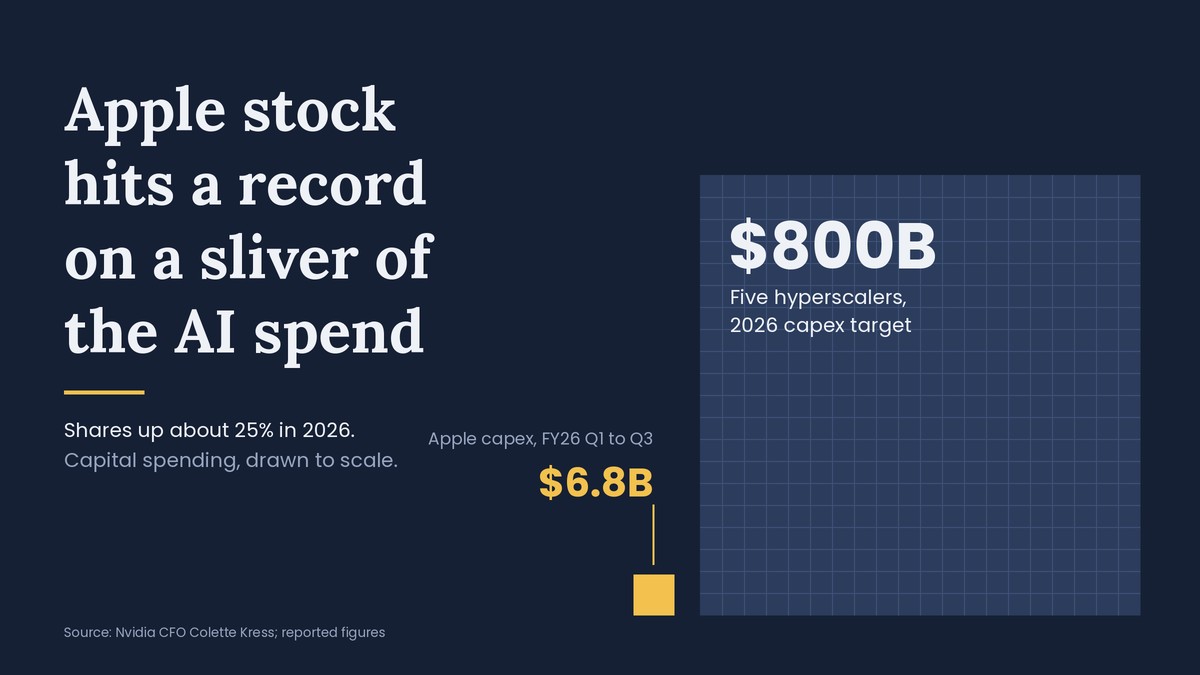
Apple has spent a small fraction of what its Big Tech peers are pouring into artificial intelligence infrastructure, and investors don’t seem to mind. Apple stock is up about 25% in 2026 and trading at a record high. Over the same period, the company has avoided the data center arms race that defines most of the industry.
The number that captures the difference is $6.8 billion. That is Apple’s total capital spending through the first three quarters of fiscal 2026. The five largest hyperscalers, by contrast, are targeting roughly $800 billion in capital expenditures this year, according to comments Nvidia chief financial officer Colette Kress made on the chipmaker’s latest earnings call. Apple’s nine-month total is less than 1% of what that group plans to spend in a single year.
The gap matters now because Apple has just released a beta version of its long-awaited AI-powered Siri. Wall Street has repeatedly criticized the company as slow on AI. Apple’s fiscal year ended in late September, so its upcoming fourth-quarter report will show whether its lean spending pattern held through the full year.
Two Very Different Bets on Artificial Intelligence
The hyperscaler playbook
The hyperscalers build and rent out computing capacity. Their AI strategy depends on spending heavily now on chips, power, and data center construction in the hope of capturing demand later. The trade-off shows up in their cash generation: free cash flow at these companies is under pressure as capital budgets climb.
Apple’s integration-first approach
Apple is taking the opposite route. It isn’t trying to become an infrastructure provider. It is folding AI features into the devices and services its customers already use, with the goal of making iPhones, Macs, and subscriptions more appealing.
That approach has been visible since Apple Intelligence debuted in October 2024. The platform handles many tasks directly on the device. For heavier requests, it uses Apple’s Private Cloud Compute system, which runs on the company’s own silicon, and it hands some queries to ChatGPT through an integration added later that year. The more personalized version of Siri took longer to arrive. In March 2025, Apple said those features needed more time, which added to the perception that the company was falling behind.
The Numbers Side by Side
| Metric | Figure | Basis |
|---|---|---|
| Apple capital expenditures, first three quarters of FY2026 | $6.8 billion | Reported figures cited in market analysis |
| Hyperscaler capex target for 2026 (five companies) | About $800 billion | Nvidia CFO Colette Kress, latest earnings call |
| Apple free cash flow, FY2026 | $143.7 billion | Consensus analyst estimate |
| Apple free cash flow, FY2027 | $153.4 billion | Consensus analyst estimate |
| Apple market value | About $5 trillion | Second-largest company by market value |
| Apple stock performance, 2026 year to date | Up about 25% | Trading at a record high |
Why Free Cash Flow Is the Real Story
What the consensus numbers imply
If analysts are right, Apple will generate $143.7 billion in free cash flow in fiscal 2026 and $153.4 billion in fiscal 2027. That would be growth of roughly 7% in a year when many large tech peers are seeing cash generation squeezed by infrastructure bills.
Low capital intensity is what keeps those figures so high. Every dollar Apple doesn’t spend on data centers remains available for its long-running share buybacks and dividends, or as a cushion if the AI landscape shifts.
A note on estimates
These are forecasts, not results. Consensus estimates change with product cycles, consumer demand, and the broader economy. The fiscal 2026 actuals will be the first real test.
What Could Challenge the Low-Spend Strategy
Execution on Siri
The new Siri is still in beta, so any judgment of its quality is preliminary. If users find it meaningfully better, the argument that Apple can win in AI without massive infrastructure spending gets stronger. If the reception is lukewarm, the “slow on AI” criticism is likely to return.
Reliance on outside technology
Spending less on infrastructure means Apple leans more on its own on-device models and on partnerships for the most demanding tasks. That keeps costs down but gives the company less control over the most advanced capabilities.
If the hyperscaler bet pays off
The comparison works in both directions. If the hyperscalers’ spending produces strong returns, investors may start valuing infrastructure ownership more highly. Apple’s restraint would then look less like discipline and more like a missed opportunity.
What Investors Are Watching Next
For Apple stock, three things stand out in the coming months:
- The fiscal fourth-quarter report. It will confirm full-year capital spending and free cash flow.
- The broader Siri rollout. Investors will be watching how quickly Siri moves from beta to general release.
- Hyperscaler spending plans. Any change in those budgets would affect how the market compares Apple with its peers.
For now, the market is rewarding Apple’s decision to stay out of the build-out. The next few quarters will show whether investors keep holding that view.
Disclaimer: This content was partially produced with the help of AI tools and This content is for informational purposes only and not investment advice.