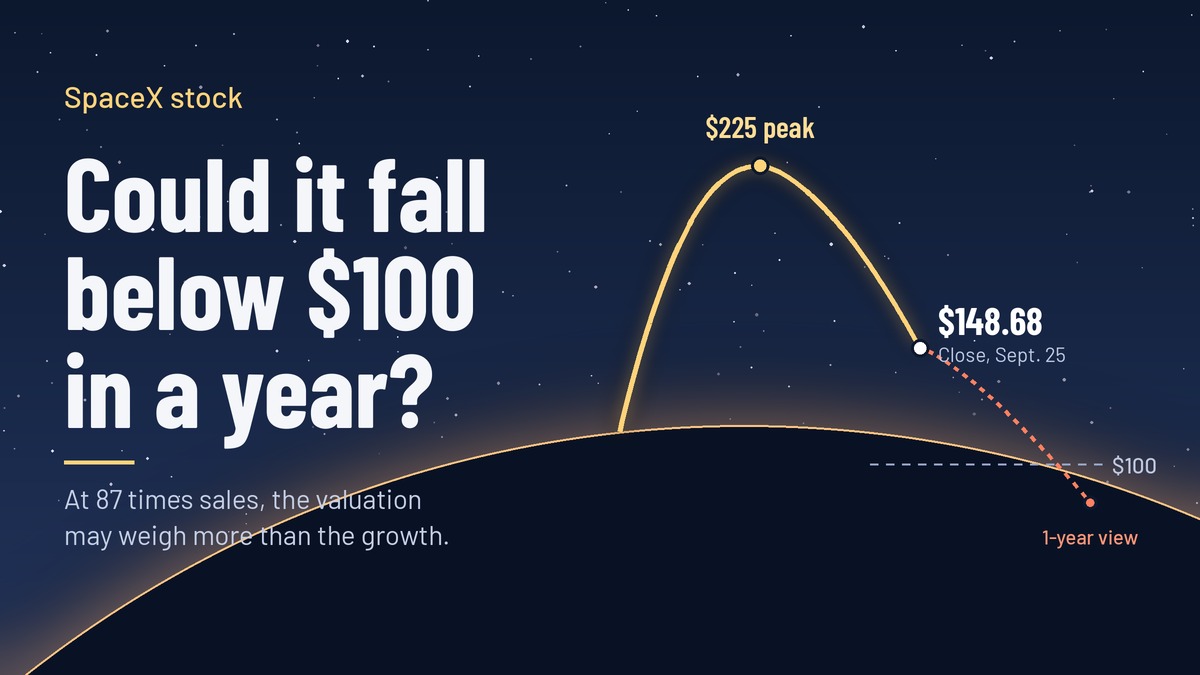
SpaceX shares closed at $148.68 on Friday, Sept. 25, about 34% below the $225 peak they reached shortly after the company’s June IPO. The slide reflects a market trying to price two things at once: growth that few companies can match, and a valuation that looks stretched by almost any standard measure.
The numbers show the tension. With a market capitalization of roughly $2.02 trillion, SpaceX trades at around 87 times the $23 billion in revenue it brought in over the past four quarters. The Nasdaq-100, home to the largest U.S. tech companies, trades at about 6.4 times sales.
That gap drives a prediction SpaceX stock investors are now weighing: shares could trade below $100 a year from now even if the business keeps expanding quickly. Whether that would be a warning sign or an entry point depends largely on how much credit investors give the company’s artificial intelligence plans.
Where SpaceX’s Revenue Comes From Today
SpaceX reported $7.8 billion in revenue for the second quarter of 2026, which ended June 30. Here is how that broke down by segment, according to company figures:
| Segment | Q2 2026 Revenue | Year-Over-Year Growth |
|---|---|---|
| Connectivity (Starlink) | $4.29 billion | 66% |
| AI | $2.56 billion | 247% |
| Space (launch) | $0.96 billion | 29% |
Starlink still carries the business
Connectivity accounted for about 55% of quarterly sales. SpaceX has put more than 10,200 Starlink satellites into orbit, serving 12 million paying customers. The next step is the V3 satellite, which offers 10 times the bandwidth of the current generation and will fly on Starship, a rocket with four times the payload capacity of Falcon 9.
AI is growing fastest
The AI segment came from SpaceX’s acquisition of xAI, Musk’s artificial intelligence start-up, earlier this year. SpaceX uses xAI’s Colossus and Colossus II data centers to train its own models and rents spare computing capacity to outside customers, including Anthropic, Reflection AI, and Alphabet. Revenue in the segment more than tripled from a year earlier.
The Valuation Math Behind the Forecast
Trailing sales
On the past year of revenue, SpaceX is roughly 13 times more expensive than the Nasdaq-100 on a price-to-sales basis. Even for a company growing this fast, that is a steep premium over the most established names in tech.
Forward estimates
Wall Street’s average forecast, as compiled by Yahoo Finance, calls for $108.3 billion in total revenue in 2027. Using that figure, SpaceX’s forward price-to-sales ratio falls to about 18.5. That is far more reasonable, but still roughly three times the Nasdaq-100’s current multiple.
For SpaceX to trade in line with the index on forward sales, the stock would need to drop about 65%, to roughly $52. The analysis behind the sub-$100 prediction does not expect a decline that severe, citing the company’s long-term potential, but it illustrates how much optimism is already built into the price.
The $100 billion question
Much of that optimism rests on a single forecast. SpaceX chief financial officer Bret Johnsen has said the AI business could reach $100 billion in annualized run-rate revenue by the end of 2026, driven by intense demand for data center capacity. That is a projection, not a reported result. If it holds, the AI unit alone would generate several times the combined annualized revenue of the space and connectivity segments, and analysts’ 2027 estimates suggest the Street is giving it meaningful weight.
What Could Support the Long-Term Bull Case
Starmind and computing in orbit
SpaceX recently developed Starmind, a satellite carrying a version of Nvidia’s Vera Rubin data center systems. The idea is to process AI workloads in orbit, powered by solar energy and without the costly cooling that ground-based facilities need. Results would travel back to Earth over the existing Starlink network, a distribution advantage few competitors could replicate.
Pressure on ground-based data centers
Lawmakers in more than a dozen U.S. states have introduced bills that would temporarily halt new data center construction while officials study the social, economic, and environmental effects. Heavy electricity and water use has turned AI infrastructure into a political flashpoint. Space-based computing sidesteps many of those concerns, which could make it attractive to AI companies if the technology scales.
Background: the launch business
SpaceX was founded by Elon Musk in 2002 with the goal of cutting the cost of reaching orbit. Its reusable Falcon 9 and Falcon Heavy rockets now carry about 2,500 tons of commercial payload to orbit each year. Musk has argued that governments and businesses may eventually need as much as 10 million tons of satellites, AI hardware, and other equipment launched annually, which would make today’s launch market a small fraction of its potential size.
What to Watch Over the Next Year
The prediction SpaceX stock skeptics and bulls are both watching will hinge on a few concrete markers: whether AI revenue tracks toward Johnsen’s run-rate target, how quickly Starship begins deploying V3 satellites, whether Starmind moves from prototype to commercial service, and how state data center legislation develops. A share price below $100 would reflect valuation catching up with fundamentals, and the original analysis frames that scenario as a potential opportunity for long-term investors rather than a verdict on the business.
Disclaimer: This content was partially produced with the help of AI tools and This content is for informational purposes only and not investment advice.